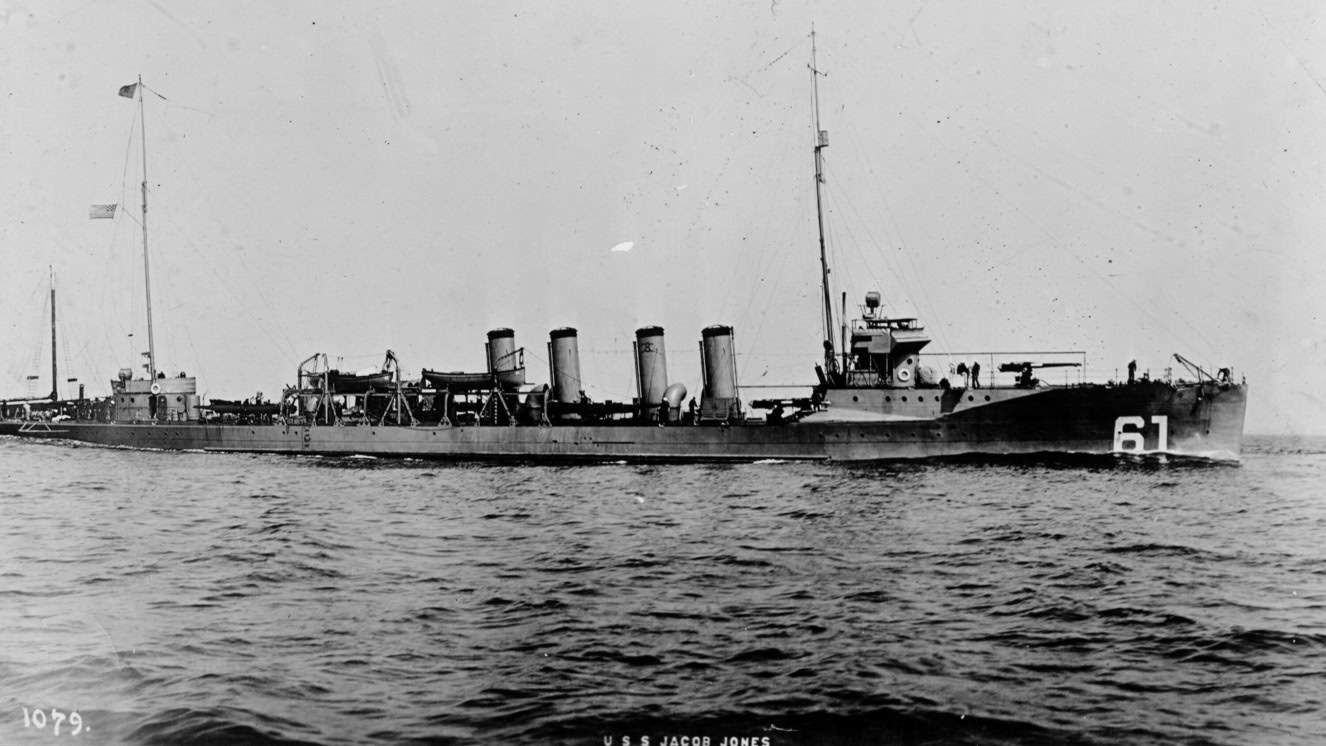
USS Reuben James: The Forgotten First US Navy Vessel Sunk in WWII

“Have you heard of a ship called the good Reuben James? Manned by hard-fighting men both of honor and fame?” Probably not. After all, she was one of the many, many ships sunk during the Battle of the Atlantic, the six-year-long naval campaign the Allies waged against the Axis powers on, above, and below the salty waters of Earth’s second-largest ocean. But the US Navy destroyer USS Reuben James differed from those other lost American vessels lost in the fight against the Axis Powers in one important way: the Germans sank her in late October of 1941, over a month before the Japanese attack on Pearl Harbor spurred America to formally enter the Second World War. Thus, the Reuben James has the tragic distinction of being the first US Navy ship sunk by enemy action during the conflict.
The History of the USS Reuben James
Commissioned in September of 1920, the ship was named after Boatswain’s Mate Reuben James, an American Sailor who served in the Navy for over thirty years in the late eighteenth and early nineteenth centuries and fought bravely during the First Barbary War (during which he or another Sailor named Daniel Frazer risked his life to save their commanding officer, the legendary Stephen Decatur). For the next decade, the ship sailed the Atlantic, Caribbean, and seas around Europe, fulfilling all manner of peacetime duties until the Navy decommissioned her in July 1931. But her retirement turned out to be a brief one.
Recommissioned in 1932, the Reuben James returned to active service and the sort of work she had during the 1920s. But things began to change for her and the rest of the US Navy after Germany’s invasion of Poland in September of 1939, which kicked off WWII. While the United States at the time maintained a strict, isolationist policy of neutrality, the armed forces began preparing on the assumption that, however unlikely it seemed at the time, the US would get into the war at some point. In early March of 1941, the Navy established the Support Force, Atlantic Fleet, a force of ships and planes intended to protect American supply convoys carrying arms and equipment to Europe under the auspices of the soon-to-be-passed Lend-Lease Act.

America and the Lend-Lease Act
First proposed by President Franklin Roosevelt in January of 1941, the Lend-Lease Act was a way the US could support the Allies’ fight against the Axis while ostensibly remaining neutral. The basis for it dates back to the summer before, when British Prime Minister Winston Churchill requested help from the US after suffering heavy losses among the Royal Navy’s surface fleet.
Roosevelt responded by trading 50 American destroyers for 99-year leases on British bases in the Caribbean and eastern Canada. The deal caused a bit of an uproar in the states, but during his election campaign later that year, Roosevelt assured the voters that, while “your boys are not going to be sent into any foreign wars," the United States should serve as a "great arsenal of democracy" and provide arms to the countries whose defense also benefited America.
After his successful reelection, he set out to codify that idea with the Lend-Lease Act, which Congress passed on March 11th, 1941. By that summer, the US had begun sending ships full of all manner of equipment and supplies to Britain (and, eventually, the other Allies), with US Navy vessels assigned to steam alongside them as far as the seas off Iceland, where the Royal Navy took over escort duties.
The Sinking of the Reuben James
The USS Reuben James departed Halifax, Nova Scotia, along with her fellow destroyers USS Niblack, USS Hilary P. Jones, USS Benson, and USS Tarbell on October 23rd, 1941, in order to escort a 44-ship convoy of cargo vessels hauling Lend-Lease supplies across the Atlantic. Over the course of the following week, the Reuben James and her cohorts made the harrowing trip towards Europe through waters patrolled by the dreaded submarines, the U-boats, of the German Kriegsmarine (submarines had already attacked two US Navy vessels by that point, missing one entirely but damaging the second, the USS Kearny, and killing 11 of her crew).
The escort destroyers had several run-ins with sonar contacts they believed were U-boats and dropped depth charges on several occasions but struck no targets. By the early morning hours of October 31st, the still-intact convoy began passing a few hundred miles south of the west coast of Iceland. But they were not alone in those waters.
At around 5:30 am, the German submarine U-552 fired a pair of torpedoes at the convoy, both of which struck the Reuben James’ port side. The explosions tore off and destroyed the entire forward portion of the ship, including the bridge, killing most of her crew and every single commissioned officer aboard. The remaining section of the destroyer quickly began to sink, forcing the survivors to abandon ship and take to the three remaining lifeboats or rely on their life jackets.
As the stern sank, several of the ship’s depth charges exploded, killing several of her Sailors who survived the initial torpedo attack. Luckily, the commander of the escort ships soon realized the Reuben James was missing and ordered the others to search for the missing destroyer. Approximately twenty minutes after the torpedoes doomed the Reuben James, the Niblack spotted the survivors and picked them up. Of the 159 Sailors who set out aboard the ship from Canada, only 44 made it back home.
Aftermath of the Reuben James’ Sinking
While the torpedoing of an American naval vessel and the deaths of over 100 Sailors caused understandable outcry among the families of the lost and the military community, most of the country pretty much shrugged it off. Even in Congress, responses generally ran the gamut from advocating calm to seeing the attack as an inevitable result of supplying the Allies against the Germans.
America would not reach the point where taking direct part in WWII became inevitable until she lost seven more warships, all of them sunk at Pearl Harbor. Thus, the Reuben James and her valiant crew wound up as historical footnotes in the history of the war.
That said, while the deaths of 115 Sailors may not have affected most Americans all too deeply, it struck a somewhat literal chord with one. After hearing of the sinking, the great folksinger Woody Guthrie began writing a song to honor the ship and her crew in the hopes that his countrymen would not forget her or the men aboard her. The song “The Sinking of the Reuben James” begins with the verse:
Have you heard of a ship called the good Reuben James
Manned by hard fighting men both of honor and fame?
She flew the Stars and Stripes of the land of the free
But tonight, she's in her grave at the bottom of the sea.
And each chorus is the following question asked twice:
Tell me what were their names, tell me what were their names,
Did you have a friend on the good Reuben James?
During the war, Guthrie joined the Merchant Marine, traversing the battle-ravaged Atlantic aboard convoy ships several times. Like the survivors of the Reuben James, he too faced the threat of German U-boats, surviving two torpedo attacks over the course of his service. And he made sure that, in some small way, the men who died on that oft-overlooked destroyer lived on in song.
Continue Reading
105 Years Later, the First U.S. Navy Destroyer Shipwreck Is Found
Military History
The Sinking of the USS Panay: The Forgotten First Clash with Imperial Japan
Military History
Join the Conversation

BY PAUL MOONEY
Veteran & Military Affairs Correspondent at VeteranLife
Marine Veteran
Paul D. Mooney is an award-winning writer, filmmaker, and former Marine Corps officer (2008–2012). He brings a unique perspective to military reporting, combining firsthand service experience with expertise in storytelling and communications. With degrees from Boston University, Sarah Lawrence Coll...
Credentials
Expertise
Paul D. Mooney is an award-winning writer, filmmaker, and former Marine Corps officer (2008–2012). He brings a unique perspective to military reporting, combining firsthand service experience with expertise in storytelling and communications. With degrees from Boston University, Sarah Lawrence Coll...