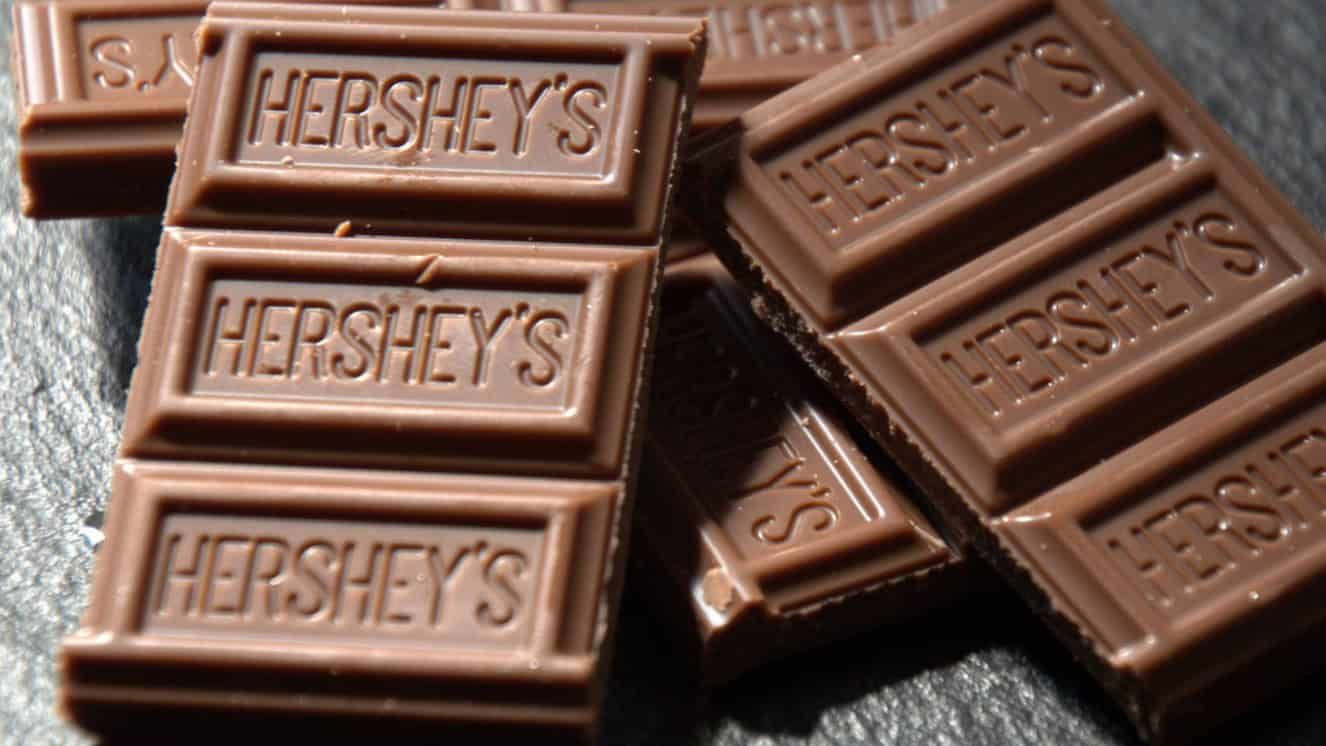
Ration Bars & Candy Disks: How WWII Helped Make Hershey and Mars the Candy Kings

As October rolls on and Halloween nears, folks are prepping for the most spooky of holidays. That means carving pumpkins, spreading cobwebs, posing fake skeletons, planning out costumes, and, perhaps most importantly, buying candy. Candy of all kinds and lots of it. Like, literal tons of it. And while there are a great many different companies that produce tons of delicious, tasty treats, the two undisputed heavyweights of candy production here in America are Hershey and Mars.
These household names are printed on the vast majority of sugary goodies consumed in this country, including most of those doled out every October 31st. And while there are many reasons these two confectionary companies continue to dominate the candy market in the States, the story of their dominance goes back to a somewhat surprising source: the Second World War, colorful candy discs still widely snacked on today, and arguably one of the worst prepacked military meals in modern history (which, as any servicemember or Veteran will tell you, is really saying something).
Hershey and Mars: The Early Years
Founded in 1894 by Pennsylvania confectioner Milton S. Hershey as a subsidiary of his Lancaster Caramel Company, the Hershey Chocolate Company began manufacturing its first milk chocolate bars in 1900. The first products of their kind were manufactured in America, and proved so popular that they turned Hershey into a massive success.
By 1905, the company had completed construction of the world’s largest chocolate production plant in the world, in the area of Hershey’s birthplace, Derry Township, PA. This town would eventually be known as Hershey, Pennsylvania. The following year, Hershey opened a park to provide leisure and recreational activities to the local populace, which soon included rides and other amenities. Today, it's the Hersheypark amusement park. In 1907, the company began producing its second iconic confectionery, Hershey’s Chocolate Kisses, and added the peanut-filled Mr. Goodbar in 1925.
Named not after the Roman god of war or the planet that shares his moniker (as this writer may or may not have believed before researching this piece), Mars, Incorporated took its name from Frank C. Mars, who founded the company in 1911. After nine years spent making and selling buttercream candies out of his home in Tacoma, Washington, he moved the company to Minneapolis in 1920.
Three years later, Mars debuted its first, arguably still most famous candy bar: the Milky Way. In 1929, the company moved again, this time to Chicago, Illinois, where it introduced the popular Snickers and Three Musketeers candy bars, which helped make Mars another corporate giant in the world of American candy makers during the 1930s. By 1935, they’d expanded into Europe and into a new industry: pet care products.

World War II and the Hershey D Ration
In 1937, with a major worldwide conflict looking increasingly likely, the U.S. military reached out to Hershey and asked them to create a durable, long-lasting field ration bar that troops could carry with them in the field. According to the company’s chief chemist at the time, the government specifically requested that the bar weigh a mere four ounces, contain a whole lot of calories, could withstand extremely high temperatures, and “tasted a little better than a boiled potato.” While that last point may seem like some sort of amusingly cruel prank played on frontline troops, there was actually a good reason for it. If the bars tasted any good, they might enjoy eating them whenever they felt like it rather than holding off until they really needed to.
In response to the military’s request, Hershey created a 600-calorie brick of chocolate, sugar, cocoa butter, powdered skim milk, oat flour, and vitamin B1 dubbed the D Ration Bar. Having hit every one of the required parameters, the bar was exactly what the Armed Forces asked for. And exactly what they would need.
By the time WWII formally broke out in 1939, Hershey had greatly expanded their daily capacity to produce the ration bars. By the time the United States entered the conflict in 1941, the company was cranking out bars as fast as possible. Between 1940 and 1945, they produced and distributed over three billion D rations for the military.
In 1943, Hershey also created and began distributing their new Tropical Chocolate Bars, specifically designed to withstand heat even better than the D ration (and to taste at least slightly better). And while it’s almost certain that nobody found the flavor of the D rations or Tropical Bars all that palatable, the fact that they found their way into the mouths and stomachs of millions of American (and Allied) troops, POWs, refugees, and civilians in every theater of the conflict helped make Hershey a household name across the world.
World War II, the Mars Family, and M&Ms
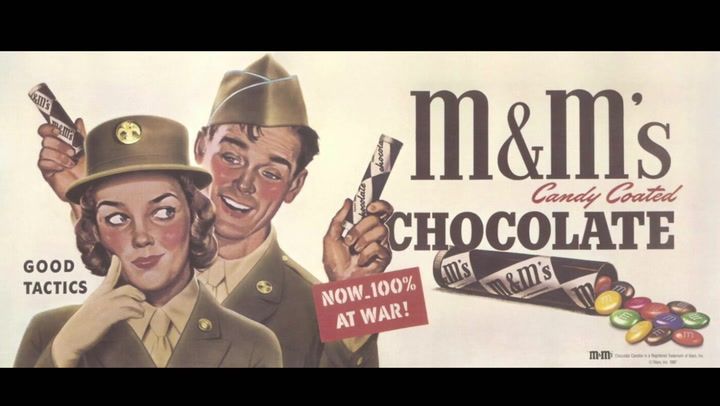
Hershey bars weren’t the only sweets US troops carried into the fighting, as Mars had their own unique goodies to offer that Soldiers, Sailors, and Marines could easily eat on the go. Ones that would, as you may have heard, “melt in your mouth but not in your hand.” Sometime during the 1930s, while working in Europe, Frank Mars’ then-estranged son Forrest took notice of a particular type of candy popular among troops fighting in the Spanish Civil War: small chocolate pieces covered in a coat of hard sugar (most likely Smarties produced by Swiss candy company Nestlé) that prevented them from easily melting in the heat.
After returning to the United States, he and Bruce Murrie (the son of a Hershey executive) worked together to develop their own version of the candy. In the fall of 1941, Mars began producing M&Ms (the letters of the creators’ last names) for a single client: the U.S. Army. Throughout the war, Soldiers happily noshed on packets of the candies. So, when Mars finally introduced them to the civilian market in 1947, they already had plenty of fans of their tasty chocolate tidbits.

The Military, Hershey, and Mars Since WWII
Given their popularity before the war, it’s likely these two chocolate and candy companies would still be household brand names today. But the widespread distribution of the D ration, Tropical Bars, and M&Ms during WWII almost certainly helped turn them into unquestionable juggernauts of sweet snacks both at home and abroad. And it wasn’t even the last time they found themselves involved in a military narrative.
In 1948, after Soviet Premier Joseph Stalin ordered a blockade of West Berlin to try and force their former western allies to abandon the half of the city they controlled, the US and Great Britain began airdropping food and fuel to their half of the German capital. Not long after the Berlin Airlift began, Air Force pilot Veteran Gail "Hal" Halvorsen, a WWII Veteran initially unhappy to supply aid to citizens of a country he so recently fought against, found himself moved after speaking to a group of German children crowding the fence around the airbase he flew out of.
He talked some of his fellow servicemembers into donating their chocolate rations (Hershey bars, to be specific), which, in addition to his, he dropped out of his aircraft over Berlin attached to small parachutes made from handkerchiefs and string. The story of his small but heartwarming effort (on top of his work flying supplies for the airlift) inspired other fliers and candymakers, which led to Operation Little Vittles, during which American pilots parachuted over 23 tons of candy into Berlin. And it earned Halvorsen, among several other nicknames, the sobriquet “The Berlin Candy Bomber.”
As for Mars, well, they haven’t had an official partnership with the military since WWII. But as anybody who’s ever ripped open an MRE to happily find it includes “pan-coated chocolate discs” or “pan-coated oval/round milk chocolate with peanuts” (Mars introduced the peanut M&M in 1954), the influence of that company on the morale of servicemembers from every branch of the U.S. military continues.
Continue Reading
Combat Confections: Chocolate Bars, M&M's, and More
Lifestyle
Watch the Video
Join the Conversation

BY PAUL MOONEY
Veteran & Military Affairs Correspondent at VeteranLife
Marine Veteran
Paul D. Mooney is an award-winning writer, filmmaker, and former Marine Corps officer (2008–2012). He brings a unique perspective to military reporting, combining firsthand service experience with expertise in storytelling and communications. With degrees from Boston University, Sarah Lawrence Coll...
Credentials
Expertise
Paul D. Mooney is an award-winning writer, filmmaker, and former Marine Corps officer (2008–2012). He brings a unique perspective to military reporting, combining firsthand service experience with expertise in storytelling and communications. With degrees from Boston University, Sarah Lawrence Coll...