F-22s Were Planned for the Super Bowl LX Flyover, Then Operational Taskings Took Over

In the military, there is a saying: always have a backup plan, because the first one won’t work.
It reflects a simple reality. No matter how thorough the planning, something can always derail an operation. That is why good planners always build redundancy into their work, a backup, and a backup to the backup.
The Super Bowl LX flyover was no exception.
What the Air Force Says Happened
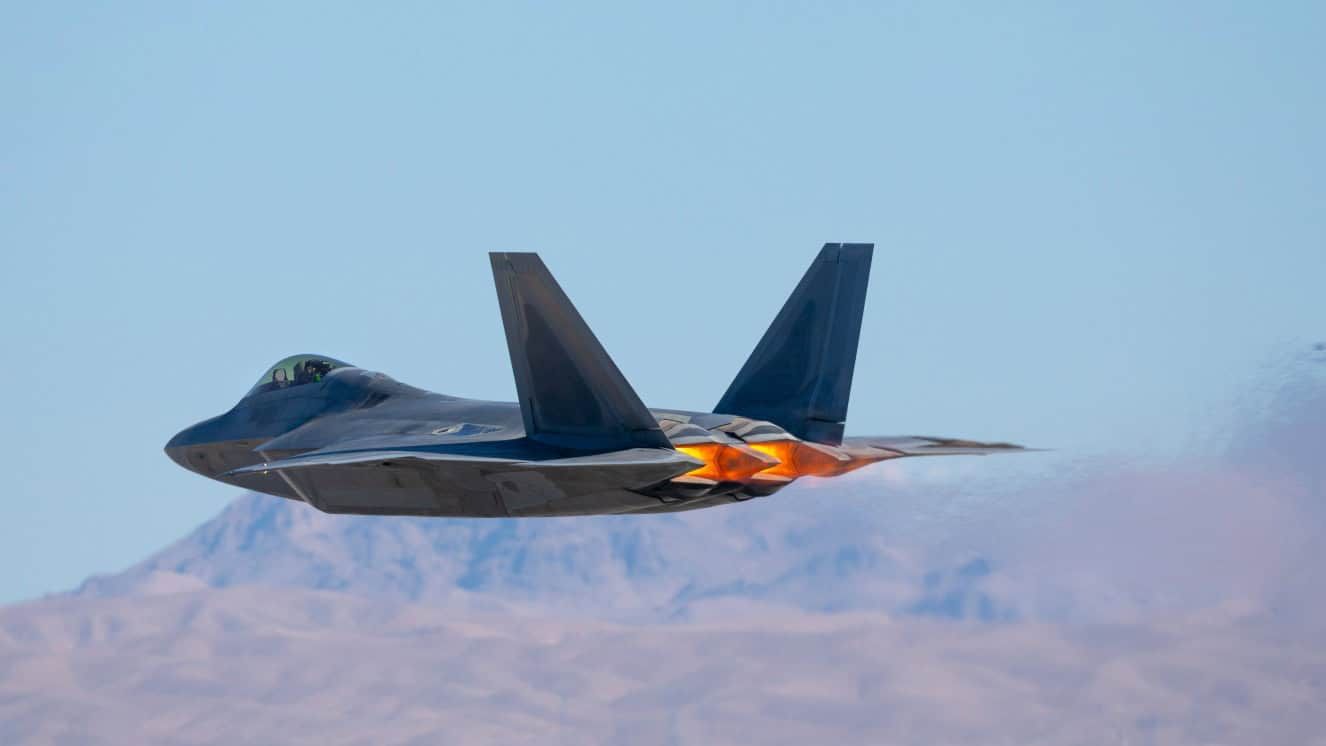
Katie Spencer, the Department of the Air Force’s Sports Outreach Program manager, told Military Times that the initial plan included two F-22 Raptors to place a fifth-generation Air Force fighter in the same formation as the Navy’s fifth-generation F-35C. Those aircraft, however, were later diverted to higher-priority operational taskings.
Her explanation was blunt and familiar to anyone who has watched a “nice-to-have” support mission collide with the operational calendar:
“We wanted fifth-generation aircraft from the Air Force and fifth-generation aircraft from the Navy,” Spencer said. “But as things happen in our military, operational tempo has increased, and so the F-22s got pulled for some operational assignments.”
To fill the gap, Spencer said the Air Force tapped F-15Cs from Fresno Air National Guard Base late in the planning cycle, adding that Guard members “stepped in to fill that role.”
As a result, instead of the F-22s depicted on the commemorative patch, two F-15C Eagles from the 144th Fighter Wing joined the eight-ship formation, flying alongside two Navy F/A-18 Super Hornets and two Air Force B-1B Lancers. The Griffins of the California Air National Guard’s 194th Fighter Squadron also showcased the Air Force’s air-superiority configuration during the flyover.
Who Flies the F-22 Today?
The U.S. Air Force’s F-22 Raptor fleet is concentrated in a relatively small number of active-duty, Air National Guard, and associate units. Together, these squadrons form the core of America’s premier air-dominance capability.
Active-duty wings provide the primary operational backbone, while Guard and Reserve units contribute through classic and associate partnerships that integrate personnel, aircraft, and missions.
Active Duty
Joint Base Langley–Eustis, Virginia
1st Fighter Wing
- 27th Fighter Squadron “Fightin’ Eagles”
- 94th Fighter Squadron “Hat in the Ring”
Joint Base Elmendorf–Richardson, Alaska
3rd Wing
- 90th Fighter Squadron “Dicemen”
- 525th Fighter Squadron “Bulldogs”
Air National Guard
Joint Base Pearl Harbor–Hickam, Hawaii
154th Wing (Hawaii ANG)
- 199th Fighter Squadron “Sentry Aloha” (Associate Unit)
Associates with: 19th Fighter Squadron (15th Wing, Active Duty)
Langley Air Force Base, Virginia
192nd Wing (Virginia ANG)
- 149th Fighter Squadron “Fighting Highlanders” (Associate Unit)
Associates with: 27th and 94th Fighter Squadrons (1st Fighter Wing)
Air Force Reserve Command
Joint Base Elmendorf–Richardson, Alaska
477th Fighter Group (AFRC)
- 302nd Fighter Squadron “Red Dragons” (Associate Unit)
Associates with: 90th and 525th Fighter Squadrons (3rd Wing)

Flyovers Are Fun and Good Training
Flyovers are spectacular and fun to watch, but they serve two serious purposes. They help Americans see and understand their Air Force, and they provide aircrews with valuable training.
Those missions reinforce skills such as formation flying with dissimilar aircraft, complex mission planning, and precise time-over-target execution. One of airpower’s greatest strengths is the ability to coordinate assets across long distances and combine unique capabilities at a specific time and place to achieve effects.
Whether that effect is inspiring a stadium crowd or striking a target, the planning and execution processes are largely the same.
In recent years, F-22s have participated in numerous combat and rotational deterrence operations, including the attacks on Iranian nuclear facilities and the capture of Venezuelan President Nicolas Maduro. F-22s from the 1st Fighter Wing were publicly reported as participating in the Venezuelan operation.
These kinds of missions, along with major exercises and overseas deployments, place continuous demands on a small and highly specialized fleet.
The Takeaway
Super Bowl flyovers are often marketed as pageantry, but the operational truth is more prosaic. They are training sorties, shaped by readiness requirements and real-world scheduling constraints.
This year, the commemorative patch quietly reflected an early intent to showcase America’s premier air-superiority fighter. In the end, however, the Raptors were pulled when operational taskings came calling, and a capable Guard unit stepped in to ensure the mission was still executed professionally and on time.
It was a small reminder that, even on America’s biggest sports stage, military operations always come first.
Join the Conversation

BY MICKEY ADDISON
Military Affairs Analyst at VeteranLife
Air Force Veteran
Mickey Addison is a retired U.S. Air Force colonel and former defense consultant with over 30 years of experience leading operational, engineering, and joint organizations. After military service, he advised senior Department of Defense leaders on strategy, readiness, and infrastructure. In additi...
Credentials
Expertise
Mickey Addison is a retired U.S. Air Force colonel and former defense consultant with over 30 years of experience leading operational, engineering, and joint organizations. After military service, he advised senior Department of Defense leaders on strategy, readiness, and infrastructure. In additi...