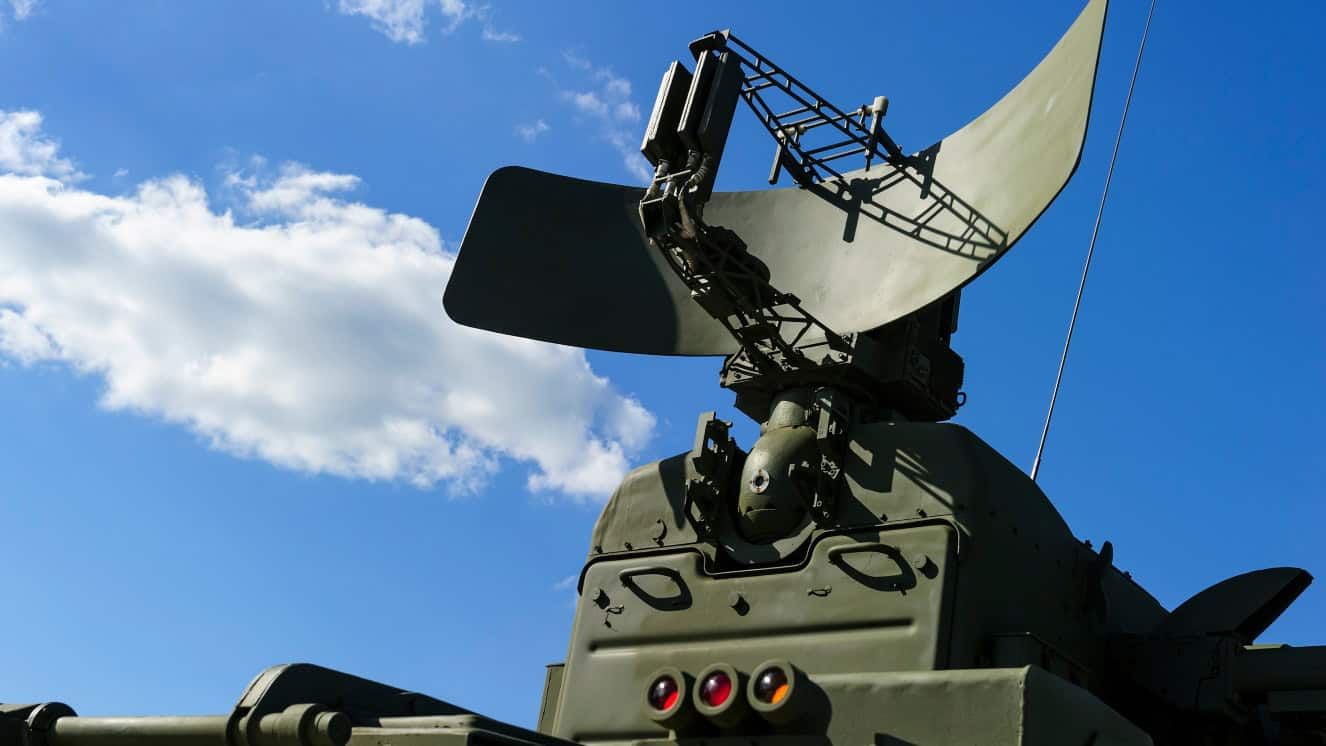
Patriot Missile System: Key Role in Ukraine and Israel Defense

“If it flies, it dies!”
This is the motto of the US Army’s Air Defense Artillery (ADA) branch that is taken very seriously. Their job is to defend against enemy aircraft, cruise missiles, theater ballistic missiles, and Unmanned Aerial Vehicles. Since the dawn of aerial warfare, the threat of bombardment from the skies has sent shivers through the souls of many soldiers.
In this article, we’ll briefly look at the history of US Army ADA and focus on the current state of the art in ADA weapons technology – the MIM-104 Patriot surface-to-air missile/anti-ballistic missile system.
As war continues to rage between Russia and Ukraine, the Patriot has captured headlines as the most sought-after military hardware needed by Ukraine to defend against Russian air attacks. And, during Israel and Iran’s recent military exchanges, the Patriot proved critical in helping Israel defend itself against the hundreds of surface-to-surface missiles Iran launched against them.

Army Air Defense Artillery: Historical Overview
With America’s entry into World War I in 1917, the Secretary of War recommended the creation of an anti-aircraft artillery (AAA) service and a school to train these air defenders.
The Coast Artillery Corps assumed the AAA mission because it was the only artillery branch with experience in firing at moving targets. Using a French 75 mm gun, one battalion distinguished itself by shooting down nine German planes in a 118 day period. After the war, all US AAA units were demobilized and the AAA service ceased to exist until 1920.
By 1930, a new emphasis was placed on anti-aircraft artillery. In 1938, the War Department added additional emphasis when $800,000 was provided to procure mobile anti-aircraft guns and mounts. Air power played a greater role in World War II than it had in World War I, and the need for AAA was greater than ever.
The Germans demonstrated this as their blitzkrieg swept through Europe in 1939 and 1940. The need for AAA defense in the Pacific became equally obvious. The technology used to perform the mission remained limited to different caliber guns often supported by searchlights to support detection of enemy aircraft at night.
After WWII ended and the Cold War began shortly thereafter, guns ultimately gave way to long-range air defense missiles to counter the threat of long range nuclear bombers flying at extremely high altitudes.
In 1945, the Army proposed to develop a line-of-sight anti-aircraft missile system. The so-called Nike project delivered the United States' first operational anti-aircraft missile system, the Nike Ajax, in 1953. The missile's first-stage solid rocket booster became the basis for many types of rocket, including the Nike Hercules missile and NASA's Nike Smoke rocket, used for upper-atmosphere research.
The Nike program opened the door for the development of several Army missile programs developed and fielded to defend against enemy aircraft, cruise missiles, theater ballistic missiles and intercontinental ballistic missiles. Development and fielding of these important programs continue today with the most ubiquitous being the Patriot system.
Patriot Missile System: Detailed Overview
The MIM-104 Patriot is a mobile interceptor missile surface-to-air missile (SAM) system, the primary such system used by the United States Army and several allied nations.
It is manufactured by the U.S. defense contractor Raytheon, and derives its name from one of the two radars that are part of the Patriot system. The older, and original, AN/MPQ-53 radar is known as the "Phased Array Tracking Radar to Intercept on Target," which is an acronym for "Patriot."
In 1984, the Patriot system began to replace the Nike Hercules system as the U.S. Army's primary high to medium air defense (HIMAD) system and the MIM-23 Hawk system as the U.S. Army's medium tactical air defense system.
In addition to defending against aircraft, Patriot is the U.S. Army's primary terminal-phase anti-ballistic missile (ABM) system. As of 2016, the system is expected to remain fielded until at least 2040.
Patriot Missile System: Operational Mechanism
Six elements comprise the Patriot system: the Radar Sets, Engagement Control Station (ECS), Antenna Mast Group, Electric Power Plant, Launching Station, and Missiles.

Radar Sets
A Patriot can be equipped with one of two radar sets – the AN/MPQ-53 Radar Set supports units that launch the PAC-2 missile while the AN/MPQ-65 Radar Set supports units that launch the PAC-2 and PAC-3 missiles.
The AN/APQ-65 Radar Set has increased search, detection and tracking capability over the older AN/MPQ-53 Radar Set.
ECS
The AN/MSQ-104 or the newer AN/MSQ-132 Engagement Control Station (ECS) is the nerve center of the Patriot firing battery. The ECS consists of a shelter mounted on the bed of an 5-Ton Cargo Truck or on the bed of a Light Medium Tactical Vehicle (LMTV) cargo truck.
The main subcomponents of the ECS are the Weapons Control Computer (WCC), the Data Link Terminal (DLT), the UHF communications array, the Routing Logic Radio Interface Unit (RLRIU), and the two-person operator stations that serve as the system's human machine interface.
The ECS is air conditioned, pressurized to resist chemical/biological attack, and shielded against electromagnetic pulse(EMP) or other such electromagnetic interference. The ECS also contains several radios to facilitate voice communications.
Antenna Mast Group
The OE-349 Antenna Mast Group (AMG) is mounted on 5-Ton Cargo Truck.
It includes four antennas that enable communication between the ECS and operators in the Information Coordination Center (ICC) who coordinate missile launches and transmit and receive information within the tactical data link network to and from other units participating in that network.
Electric Power Plant
The EPP-III Diesel-Electric Power Plant (EPP) is the power source for the ECS and Radar Sets. The EPP delivers its power to the Radar and ECS through cables stored in reels alongside the generators.
Launching Station
The M903 Launching Stations are remotely operated, self-contained units. The ECS controls operation of the launchers through each launcher's DLT, via fiber optic or radio data link meaning that the ESC operators do not have to be co-located with the launchers.
Modern versions of the launcher can carry four PAC-2 or up to 16 PAC-3 missiles.
Missiles
Two types of missiles can be launched by the Patriot system: the PAC-2 or PAC-3.
PAC-2 missiles are optimized for engaging aircraft and have a range of up to 99 miles at a speed of Mach 3.5.
PAC-3 missiles include the CRI and MSE variants. PAC-3 missiles are significantly smaller than PAC-2s and employ "hit-to-kill" technology, destroying targets through direct impact with kinetic energy rather than a fragmentation blast. The latest versions of PAC-3 missiles can engage short-range ballistic missiles, cruise missiles, and drones at altitudes up to 15 kilometers and distances of up to 35 kilometers.

Patriot System's Operational Impact in Ukraine and Israel
In both the Ukrainian and Israeli air defense architectures, Patriot missiles perform a critically important role by intercepting and destroying enemy ballistic missiles.
While Israel has fielded an effective layered-defense strategy that includes its Iron Dome Air Defense System, David’s Sling, and Arrow Systems, they have proven not to be impervious particularly against the large-scale ballistic missile strikes launched by Iran.
In short, both Ukraine and Israel do not have enough Patriot systems in place to defend against continued massive waves of ballistic missiles. And, it doesn’t appear that Russia will slow down these attacks anytime soon.
The first US-made Patriot systems arrived in Ukraine in April 2023 from Germany. Since then, the U.S. has provided three batteries and an unspecified number of interceptors. Kiev has also received two from Germany, one from Romania and one jointly given by Germany and the Netherlands.
As a result of President Trump’s recent agreement with its European partners, Germany plans to send two additional Patriot systems to Ukraine with the understanding that it will, on an accelerated timeline, procure two new systems from the US as backfills.
The Patriot is a Growth Industry
The U.S. Army plans to stand up four new Patriot battalions in the coming years to help ease the strain on what it says is its “most stressed force element.”
This represents about a 25% increase in the service’s overall Patriot force, and even more so when it comes to units that can be deployed operationally. In its most recent budget request for FY26, the Army disclosed its intention to roughly quadruple its PAC-3 procurement plans, from 3,376 to 13,773.
Even with these increases, however, concerns remain that the number of available Patriots would be inadequate in a war against a near peer adversary like China. Ukraine is learning that lesson every day.
Continue Reading
How the Missile Defense System Protects America
Lifestyle
Join the Conversation

BY GEORGE RIEBLING
National Security Analyst at VeteranLife
Air Force Veteran
George Riebling is a retired USAF Colonel with 26 years of distinguished service as an Air Battle Manager, including operational assignments across five command and control weapon systems. He holds a Bachelor of Journalism, Radio & Television from the University of Missouri. Following his military c...
Credentials
Expertise
George Riebling is a retired USAF Colonel with 26 years of distinguished service as an Air Battle Manager, including operational assignments across five command and control weapon systems. He holds a Bachelor of Journalism, Radio & Television from the University of Missouri. Following his military c...