Korean War Veteran to Finally Receive Medal of Honor for Epic Dogfight Kept Secret for Decades

Thick gray clouds. Whorls of white snowflakes. Armor-piercing machine gun rounds. Multiple enemy jets. US Navy Lieutenant Royce Williams piloted his aircraft through them all on a cold November day in 1952. For over half an hour, this solo American naval aviator held his own against seven jet fighters, downing four of them in an aircraft that was basically a flying hunk of Swiss cheese by the time the battle ended. Considered an astounding feat of military aviation, Williams’ epic showdown with a flight of MiG-15s remains the longest dogfight in the history of the United States Navy.
Yet the full story of what happened on that snowy day remained a secret for over sixty years. But the declassification of his aerial victory in 2016 led to an even greater appreciation for Williams’ skill and courage. Skill and courage for which the now-100-year-old will soon receive a long overdue and justly deserved decoration: the Medal of Honor.
America and the Korean War
The roots of the conflict in Korea date back to the end of World War II. After the defeat of Imperial Japan in the fall of 1945, the Allies set about removing Japanese troops and civilians from the territories and countries they’d invaded since the start of the Second Sino-Japanese War in 1937 (a conflict that eventually evolved into the Pacific Theater of WWII).
They also took similar measures in the Korean Peninsula, which Japan had annexed in 1910. In the hopes of simplifying the process of demilitarization and administration, the United States and the Soviet Union divided Korea at the 38th parallel (the degree of northern latitude separating the territory roughly in half). The USSR took charge of the top half of the region, the US the south. The division was ostensibly a temporary one, but it soon became politicized as Korean communists flocked to the North and pushed their opponents to the South, where the nationalist-aligned Koreans began to amass.
At the behest of then President Harry S Truman, the United Nations took control of the increasingly divided Korea in 1947. In 1948, realizing that the communist controlled, Soviet and Chinese-backed North was becoming a dictatorial state under the control of former guerrilla leader Kim Il-Sung, the UN designated South Korea as its own, independent country.
That decision sparked armed fighting between communists and nationalists in both halves of the now formally divided Korea. And before the sun rose on June 25th, 1950, the conflict flared into a full-fledged war when North Korean forces invaded the South. Two days later, President Truman ordered US forces to support South Korean forces in their fight. And on July 7th, the UN put its full weight into supporting the South by passing United Nations Security Council Resolution (UNSCR) 84, which recommended “that all Member States providing military forces to the Republic of Korea make forces and other assistance available to a unified command under the United States of America.” So began the Korean War.

MiG vs Panther
During the early days of the Korean War, many American military aviators found themselves at a deadly disadvantage. The US’s primary fighter planes, including the Grumman F9F Panther, paled in comparison to their communist counterpart: the Soviet designed MiG-15.
Powered by a turbojet engine and featuring a pressurized cockpit, the MiG could operate at higher speeds and altitudes with far more maneuverability than any American fighters. It carried a trio of guns, a 37mm canon, and two 23mm ones, to boot. Suffice to say, the MiG-15 could outfly and outgun anything manned by an American or UN pilot at the start of the conflict.
By late 1950, the US began deploying a new fighter, the F-86 Sabre, which could go toe-to-toe with MiGs. But many of America’s military aviators continued to fly outmatched airframes like the F9F in the skies over Korea.
The Navy’s Longest Dogfight
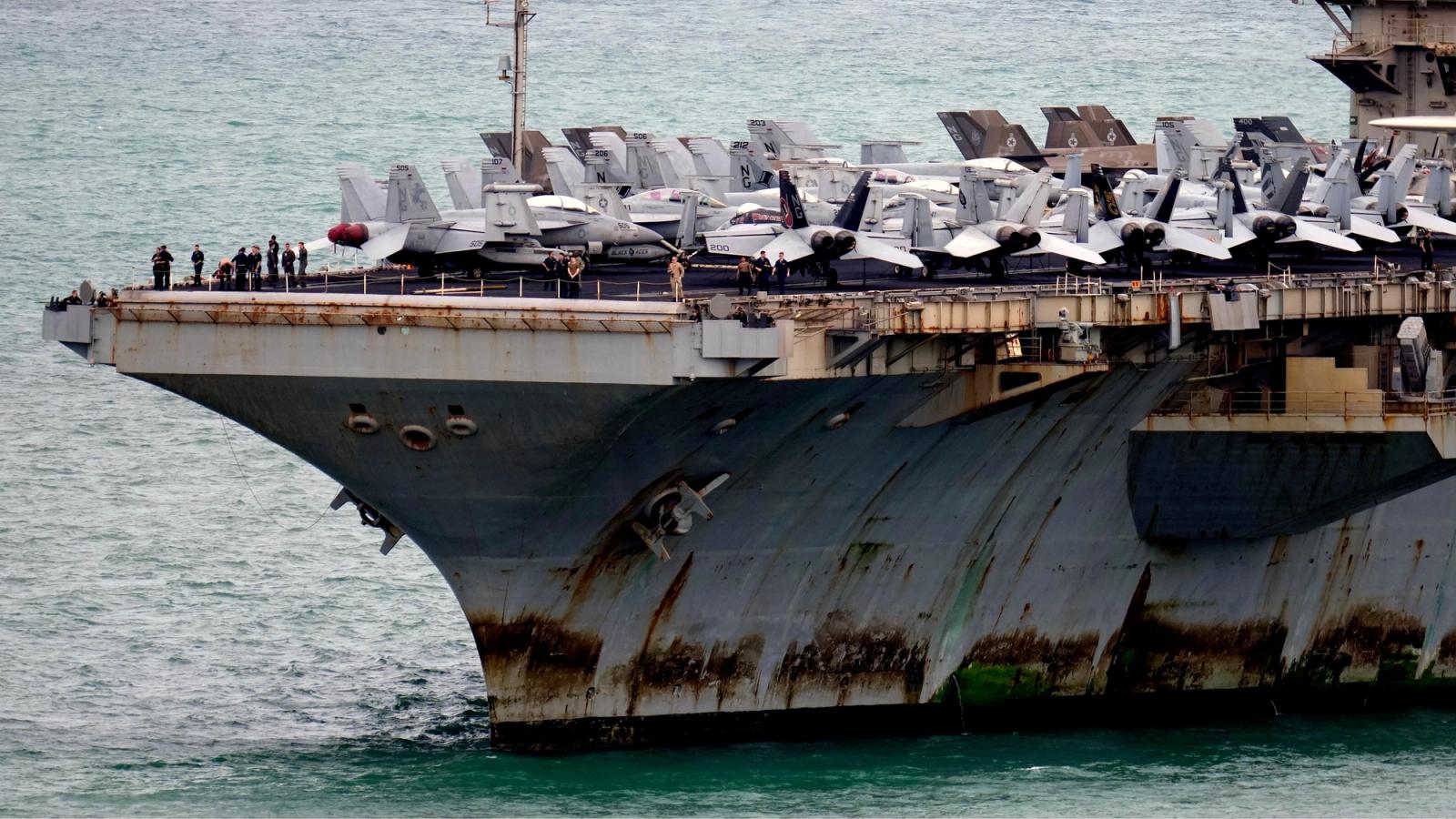
On November 18th, 1952, a flight of four US Navy F9F Panthers took off from the aircraft carrier USS Oriskany for a routine patrol of the airspace over the Yalu River, which partially separates North Korea from China.
At the stick of one of those planes sat Lieutenant Elmer Royce Williams, a South Dakota native who joined the Navy during WWII but did not complete his aviator training until shortly before the war’s end.
Not long into their patrol, radar picked up seven other aircraft in the area. Before they could engage, the flight leader’s aircraft suffered a fuel pump malfunction that forced him and his wingman to turn back. Shortly thereafter, Williams and his wingman found themselves facing those seven enemy aircraft over the Sea of Japan. All of them MiG-15s.
Knowing the pair of pilots were outmatched, their commanders ordered them to disengage. What happened next is a matter of some dispute: Williams’ wingman either successfully followed that order and immediately escaped or chased after a MiG that Williams hit, inadvertently taking himself out of the fight. Regardless, Williams soon found himself alone and penned in by six or seven far more agile, powerful, and deadly fighter planes.
So, Williams did the only thing he could: he fought. For thirty-five minutes, he went toe-to-toe with enemy aircraft that outclassed his fighter in every way, shooting down four of them while keeping his own plane in the air. Despite being hit a whopping 263 times, Williams engaged the MiGs until his ammunition ran out. He managed to slip away from the remaining fighters and limped his severely damaged Panther back to the Oriskany. He was immediately lauded as a hero, then quickly sworn to secrecy.

Keeping Slain Soviets a Secret
Jubilation over his near-miraculous victory did not last long, and not because it wasn’t impressive. Because while the US was formally engaged in military action against North Korea and their Chinese allies, it turned out that the pilots of those MiGs were from neither of those countries. They were Russians.
The Soviet Union’s support for North Korea was no secret, but the USSR was not an official combatant in the war. Publicly acknowledging that a battle took place between American and Russian troops risked sparking an international incident that could further inflame the Cold War. Thus, the Navy and the National Security Agency decided to bury the full truth of the epic dogfight.
Declassification, New Recognition, and the Medal of Honor
For the next six decades, Williams kept that full truth a secret even from his closest friends and relatives, including his wife and brother, a fellow US Navy aviator. He didn’t even bring it up when he met Dwight Eisenhower a few weeks after the fight during a visit by the then-President-Elect to US troops in Korea.
Williams continued his military service through the rest of the Korean War and into the Vietnam War, finally retiring with the rank of captain in 1980. It wasn’t until the declassification of Soviet documents related to his legendary dogfight in the 1990s and early 2000s that people finally started to learn the full extent of William’s exploits on that cold November day. Free to tell his full tale, Williams began speaking of the day he downed four Soviet jets in public during the 20-teens.
In addition to cementing his legacy as a legendary naval aviator, the declassification of his 1952 air battle sparked a campaign to upgrade the Silver Star that the Navy initially awarded him for the action. Spearheaded by fellow retired Navy officers, including multiple admirals, and the Congressman representing the California district where Williams now resides (Darrell Issa, R-CA), these efforts led to an upgrade to the Navy Cross in 2023.
Believing that Captain Williams deserved nothing less than the US military’s highest honor, Issa continued to advocate on the retired Sailor’s behalf until they succeeded. On February 4th, Congressman Issa announced that Williams, who turned 100 last April, will finally receive the Medal of Honor. While the exact date and details of the award ceremony are pending, it’s nice to know this long-obscure hero will soon receive an overdue honor befitting his service to the Navy and the United States.
Read next:
Continue Reading
After a Storied Career, Paris Davis Is Finally Receiving His Medal of Honor
Military News
Join the Conversation

BY PAUL MOONEY
Veteran & Military Affairs Correspondent at VeteranLife
Marine Veteran
Paul D. Mooney is an award-winning writer, filmmaker, and former Marine Corps officer (2008–2012). He brings a unique perspective to military reporting, combining firsthand service experience with expertise in storytelling and communications. With degrees from Boston University, Sarah Lawrence Coll...
Credentials
Expertise
Paul D. Mooney is an award-winning writer, filmmaker, and former Marine Corps officer (2008–2012). He brings a unique perspective to military reporting, combining firsthand service experience with expertise in storytelling and communications. With degrees from Boston University, Sarah Lawrence Coll...