10 of the Most Absurd & Awesome Unit Patches in the US Army

US Army history is chock full of iconic symbols forever associated with units that won victories that will echo throughout history. From the 1st Infantry Division’s Big Red One to the Screaming Eagle of the 101st Airborne, American Soldiers of all backgrounds, beliefs, origins, and ranks have bravely gone into battle sporting emblems of their units.
And while many of these iconic unit crests have become recognizable and beloved logos, others… Well, let’s just say that not every Army formation can lay claim to something that looks as cool stitched on a jacket or emblazoned on a flag. Some of them are odd, to say the least. And these are perhaps the oddest, most absurd unit patches in the US Army.
A Brief History of Military Unit Patches
The tradition of visually differentiating military units by uniform components or colors traces its roots to the heraldic traditions of 12th-century Europe, when rulers and members of the nobility created imagery to, in part, help identify the troops loyal to them on the battlefield. Over the centuries, the armed forces of most countries developed a variety of systems and symbols to distinguish different units from each other, with the earliest distinct cloth unit patches likely originating with the British Army sometime in the 1800s.
As for the United States Army, the first instances of insignia used to identify members of specific units were introduced during the Civil War. The Union Army designed a series of simple, single-color metal badges that Soldiers pinned to their jackets or caps that signified which Corps and Division they served in.
The adoption of official cloth patches sewn onto the shoulder of the uniform dates back to World War I, during the final year of which President Woodrow Wilson ordered the establishment of the Army’s Institute of Heraldry. This new organization would, among other things, designate and design official insignia for units of the US Army. In the decades since, it's designed some great ones. And also, these ten.
25th Infantry Division

While the official nickname of the Army’s Hawai’i-based infantry formation is “Tropic Lightning,” many prefer to call it by a moniker that better fits the imagery on its patch: “The Electric Strawberry.”
Yes, the outline is actually that of a taro leaf, an important plant in Hawaiian cuisine and culture, reflecting the 25th Infantry Division’s connection to the islands.
But you gotta admit, it really does give off serious electric strawberry energy.
28th Infantry Division

An unusual shape, colored red. Nothing super weird about that at first glance; plenty of Army unit patches feature unconventional outlines. And the oddness of the shape actually makes sense with a little more context.
It’s a literal “keystone,” the stone that allows an arch to maintain its shape, and the source of the official nickname of the State of Pennsylvania: the Keystone State, in reference to its geographically and ideologically central role in the origins of the United States. And the 28th is a unit of the Pennsylvania National Guard.
But while that all makes a degree of sense, it is, on its face, still an unusual shape colored red. One that, along with the intense fighting the unit saw during WWII, earned it the mildly gruesome nickname “The Bloody Bucket.”
42nd Infantry Division

Rainbows are awesome. Majestic. They are dazzling, beautiful examples of how the simple physics of the natural world can be a source of joy and wonder. Do you know what they are not? Intimidating. Tough.
They’re easily defeated by things like evaporation and heavy cloud cover. So, the decision to pick a rainbow as the symbol of an Army infantry division seems a poor one. Especially an incomplete rainbow.
I mean, you take the orange, green, indigo, and violet out of ROYGBIV, and you’re just left with RYB. No thanks.
71st Expeditionary Military Intelligence Brigade

While there’s no shortage of unit badges bearing the heads of open-mouthed mythical creatures, this is probably (hopefully) the only one where a dragon seems to be painfully electrocuted.
Seriously, it looks like a condor that licked an ungrounded socket in a Hanna-Barbera cartoon. I can almost hear it screaming.
85th Infantry Division

At first glance, this unit’s insignia seems basic and forgettable: two colors, two letters. A red “CD” over a brown background. But let’s examine what those letters stand for: “Custer Division.”
As in George Armstrong Custer, the decorated 19th-century US Army cavalry officer who, despite his valiant service during the Civil War, is best remembered for suicidally leading his troops to slaughter at the hands of several justifiably incensed Native American tribes at the Battle of the Little Bighorn in June of 1876.
While the Army is no stranger to the concept of naming things after military losers, it’s something else to make a unit sport a rather bland patch designed to recognize such an individual.
87th Infantry Division

An acorn. Just a big, gold acorn in a green circle. I know not every military unit logo needs to feature some sort of intimidating, impressive imagery, but c’mon. It’s an acorn. Its greatest enemy is a squirrel.
You couldn’t go just one step further and spring for an oak tree as your symbol?
103rd Sustainment Command

At least this unit’s patch features a plant that can do some damage: a cactus. Spiny, resilient, imposing. That said, it is still a plant. The best way to avoid the aforementioned damage it can do is to not bump into it.
XVIII Airborne Corps

This dragon is puking. People may say that’s a tongue, but it’s not. It’s projectile vomit. And that dragon is clearly in pain. Possibly due to the stress of having to continuously jump out of airplanes. While puking.
This is why some troops have aptly dubbed the symbol the XVIII Airborne Corps the “Gaggin’ Dragon.”
Army Air Traffic Services Command

So, troops, what should we put on our patch to symbolize what our unit is all about? What will instantly tell people who see our patches that we are experts in executing the unimaginably difficult process of overseeing the safe and successful takeoff and landing of Army aircraft?
Oh, I know! A mythical bird most known for regularly setting itself on fire! If that doesn’t smack of aircraft safety, I don’t know what does.
United States Army South

Um, what? How is this not a Navy unit insignia? Making a sailing vessel the symbol of an Army formation is like ordering pizza from a sushi restaurant. Utter nonsense.
Bonus Self-Deprecating Example: 11th Marine Regiment
I understand that many of my fellow Veterans and servicemembers will, upon realizing this piece lampooning the symbols of various Army units was written by a Marine Veteran, scoff and disregard it as the work of a snobbish, self-important Devil Dog.
But to prove that I enjoy mocking all branches equally, allow me to lambaste the insignia of my own regiment (granted, we Leathernecks do not sport unit insignia on our uniforms to reinforce the fact that we are all Marines first, but our various formations do have official symbols), the 11th Marines.
Between the choice of central image and the unit’s nickname, the Freudian implications ought to make anyone with a basic understanding of psychology and/or a middle schooler’s sense of humor (i.e., 99.9% of Marines) chuckle. Even if, to paraphrase a famous misquote, sometimes a canon is just a canon.
And, if it helps further assuage any annoyance at my critiques of your unit emblems, all you Soldiers out there might appreciate the fact that my father served in an above-mentioned Army division whose iconic patch looks (to me, at least) like a drunk seagull caught mid-yodel.
Continue Reading
Unique Military Punishments: Hilarious Unit Traditions
Lifestyle
Every Awesome Military Uniform From History You Need to See Now
Military History
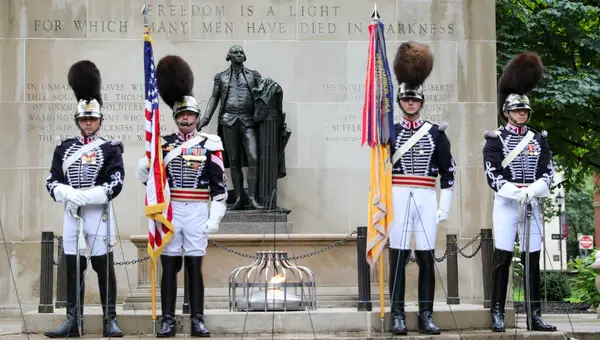
Rare US Military Uniforms: A Historical Farewell
Military History
Join the Conversation

BY PAUL MOONEY
Veteran & Military Affairs Correspondent at VeteranLife
Marine Veteran
Paul D. Mooney is an award-winning writer, filmmaker, and former Marine Corps officer (2008–2012). He brings a unique perspective to military reporting, combining firsthand service experience with expertise in storytelling and communications. With degrees from Boston University, Sarah Lawrence Coll...
Credentials
Expertise
Paul D. Mooney is an award-winning writer, filmmaker, and former Marine Corps officer (2008–2012). He brings a unique perspective to military reporting, combining firsthand service experience with expertise in storytelling and communications. With degrees from Boston University, Sarah Lawrence Coll...