Crossing the Delaware & Capturing Trenton: George Washington’s Christmas Gift to America

Americans tend to think of the year 1776 as a purely celebratory one. A year during which, on a hot July day (although not the one you may think), our nation formally declared its independence from Great Britain. But the young nation had more than its share of ups and downs during its first months of tentative existence. As a matter of fact, by the time the year neared its end, the mood among the Patriot cause was far from celebratory.
After a disastrous campaign that ended in the loss of the vital port of New York City, the battered Continental Army under General George Washington was in rough shape. It would take a pretty spectacular victory to restore any degree of confidence in the American forces’ chances of defeating one of the most powerful militaries in the world.
And in the dead of winter, with his troops hungry and desperate, Washington managed to do just that by crossing the ice-choked Delaware River to mount a surprise attack on the city of Trenton, New Jersey, the day after Christmas. The Continentals’ victory on December 26th helped ensure the survival of the nascent nation it fought for into 1777 and beyond.
Washington’s Defeat in New York: The Battle of Long Island
After ending the successful siege of Boston by forcing the British to evacuate the city in March, General Washington had good reason to feel confident. He’d taken back one of the colonies’ largest and most important cities with relatively few casualties. And he knew where the British were likely to strike next: the city of New York.
In addition to being a wealthy and populous trade hub, its location at the mouth of the Hudson River could potentially give the British control of the entirety of the river, cutting New England off from the rest of the colonies. He, along with his number two man, General Charles Lee, spent much of the summer preparing to defend the city by constructing forts at key locations around the Island of Manhattan and positioning troops across the East River in Brooklyn (then a separate city considered part of Long Island).
The British in America under the command of Admiral Richard Howe, whose powerful Navy gave them virtually uncontested control of the Atlantic Seaboard at that time, had effectively blockaded the city and set up a large camp on Staten Island under the command of General William Howe (yes, they were brothers).
From there, a force of over 20,000 British troops and Hessians (soldiers in the army of the small European state of Hesse-Kassel, now part of Germany, hired out to Great Britain) landed unopposed on the beaches of southeastern Long Island on August 22nd. On August 27th, they struck the American positions. Outnumbered more than two to one, the Continental forces in Brooklyn managed to make a fighting retreat while taking heavy casualties. Howe decided to take a few days to prepare for his next assault, during which time a storm drove his brother’s ships downriver.
Washington took the opportunity to sneak most of the surviving troops in Brooklyn across the river to Manhattan during the night of August 29th, averting what would likely have been a disaster for his Army. Now known as the Battle of Long Island (or Battle of Brooklyn), this small but costly defeat was a prelude to a series of far greater failures.
Washington’s Defeat in New York: The Fall of Manhattan
After the loss of Brooklyn, Washington repositioned most of his troops in an area on the northwestern side of Manhattan (now Morningside Heights) with an eye towards making a quick escape if the British landed and overwhelmed his defenses. Only a few thousand soldiers remained in New York City itself, which back then only took up the southernmost end of the island. He remained determined to hold the city, even going so far as to deploy a curious bit of machinery in an unsuccessful attempt to sink Admiral Howe’s flagship: the first ever submarine used in warfare, the one-man crewed Turtle.
But the fight over New York City began in earnest on the morning of September 15th when, under the cover of devastating Royal Navy broadsides, British forces began crossing the East River in rowed transports. Landing at a place on Manhattan’s eastern side called Kips Bay (about three blocks from where this author lived for six years), the redcoats quickly overwhelmed and captured the Continental troops manning nearby fortifications. As more and more British and Hessian troops crossed the river, the American forces in the city began a hasty and panicked retreat northwards.
In an attempt to stem the rout, Washington quickly rode south from where the majority of his forces were camped to take control of his fleeing Army and met them near where the stately New York Public Library now stands. Unable to prevent their flight, he is alleged to have thrown down his hat and loudly lamented, “Are these the men with which I am to defend America?” By the end of the day, the British had taken the city and most of lower Manhattan while Washington had consolidated most of his surviving forces in Morningside Heights. The next morning, British advance forces came in contact with an American unit and exchanged fire, starting the Battle of Harlem Heights. Washington sent in reinforcements, allowing the Continental troops to inflict heavy losses and force the British back.
The lines remained fairly static for several weeks until General Howe, looking to outflank Washington, sent a large force up the Hudson to attack Continental troops in New York’s Westchester County in early October. Washington took the bulk of his own troops north to confront Howe, leaving two forts overlooking the Hudson River (Fort Lee on the New Jersey side and Fort Washington on the Manhattan side) with enough troops to man them.
The two generals clashed on October 28th near what is now the city of White Plains, NY. The Battle of White Plains ended in defeat, with Washington forced to retreat yet again. Rather than pursue the Continental Army, Howe turned south and returned to Manhattan in order to take the two remaining forts occupied by American troops. Fort Washington fell on November 16th, Fort Lee fell on the 20th. The British now controlled all of Manhattan and would until the war’s end.
The Continental Army in the Winter of 1776
After taking Fort Lee, Howe continued through New Jersey in pursuit of Washington’s Army, which managed to elude him long enough to escape across the Delaware River into Pennsylvania in early December. With the coming of winter, Howe stood his army down for the season (as was standard practice for militaries at the time), leaving about 1,400 Hessians under the command of Colonel Johann Rall, stationed in the city of Trenton, New Jersey, to keep an eye on the area.
But while no longer actively pursued, Washington and his army were in dire straits. His forces shrank from casualties, desertion, and militia units leaving for home at the end of their contracted period of service. Supplies of all kinds ran low. The Continental Congress, fearing Philadelphia would fall soon after fighting resumed, fled the very city they’d declared independence from. Morale was, to say the very least, low.
In a letter to his brother, Washington wrote, “No man, I believe, ever had a greater choice of difficulties, and less means to extricate himself from them.” But with his core force of regular army soldiers and dedicated militiamen intact, he decided to carry out an attack before the year’s end. Specifically, on the day after Christmas, when the British would be unlikely to expect it.
Washington Crosses the Delaware & the Battle of Trenton
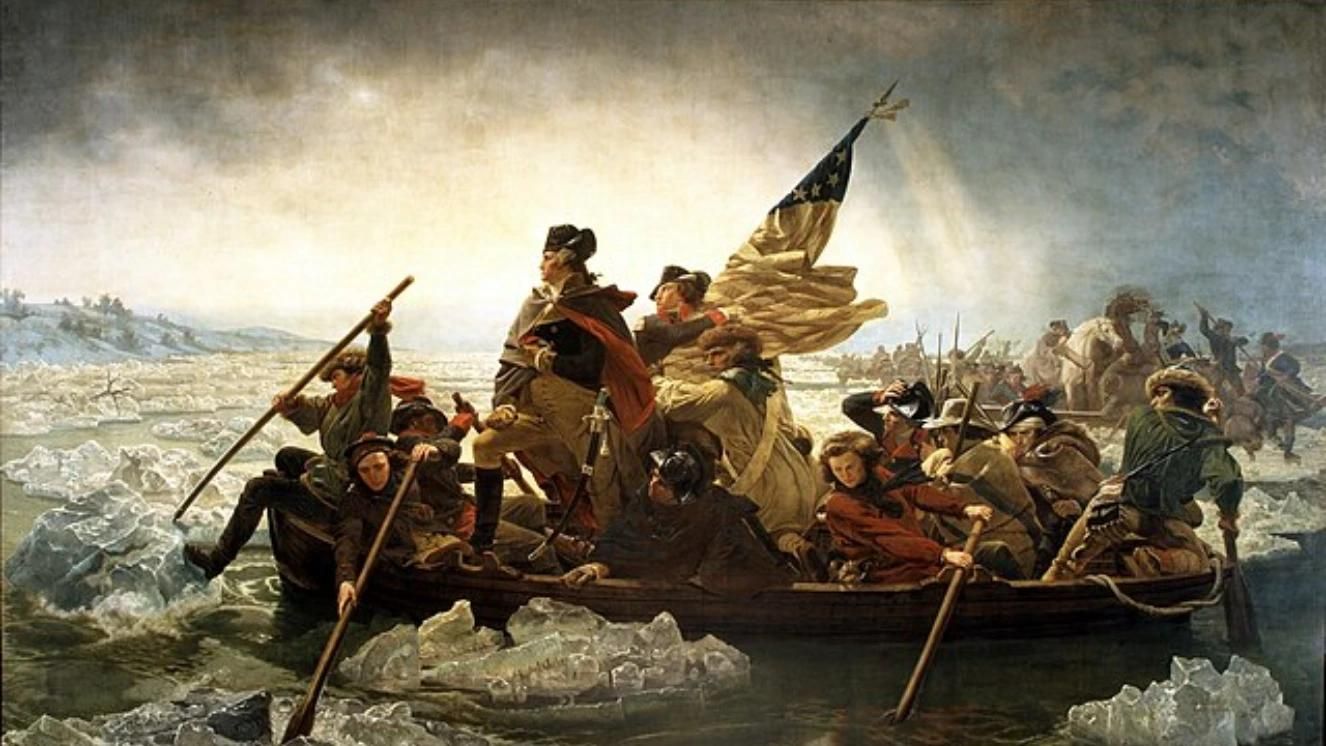
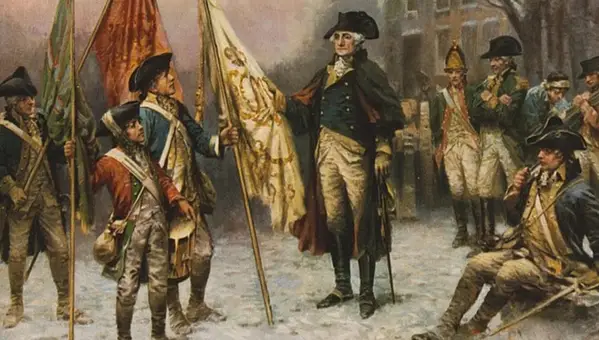
On Christmas afternoon, 1776, the men of the Continental Army began forming up along the western banks of the Delaware River. Once night fell, they began crossing the river in rowboats, struggling through ice jams, strong currents, rain that turned to snow that turned to sleet, and a bitter winter wind.
Nevertheless, and despite finishing the crossing several hours behind schedule, most of Washington’s forces, including artillery, assembled on the New Jersey side of the river in the early hours of December 26th and began marching towards Trenton, ten miles south of their landing area. They reached the city at around 8:00 am, taking the Hessian garrison completely by surprise. Colonel Rall led a valiant attempt to fight back but was soon mortally wounded.
The remaining Hessians soon either fled or surrendered, leaving the Americans in control of the city and the large amount of munitions the mercenaries had left behind. When the smoke cleared, and the Battle of Trenton ended, 20 Hessians lay dead with another 80 or so wounded, while American casualties totaled a mere five wounded, none fatally, including a young officer named James Monroe, who later went on to become the 5th President of the United States.
The Legacy of Washington Crossing the Delaware & the Battle of Trenton
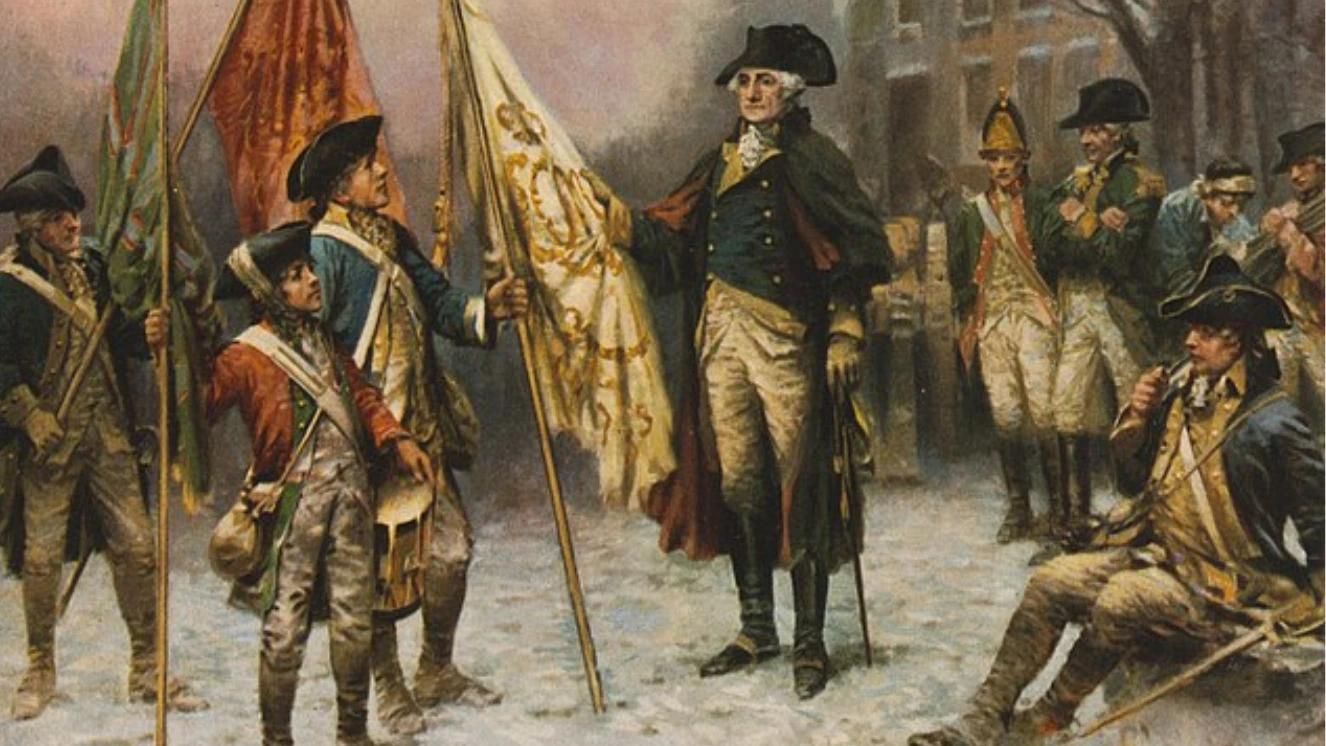
The stunning victory at Trenton galvanized the American cause in the wake of the humiliating failure of the New York Campaign. It gave General Washington and the Continental Army a much-needed victory, and the American people hope that they could win their independence. And while the Revolutionary War went on for seven more brutal years, ending only with the signing of the Treaty of Paris in 1783, the crossing of the Delaware and ensuing capture of Trenton undoubtedly helped make an American victory possible.
In the years and decades since, the image of Washington and his bedraggled troops paddling across the partially frozen river remains an iconic symbol of American resilience and grit. And in some odd twists of historic fate, the arguable most famous depiction of the event, the 1851 painting by Emanuel Leutze (an American citizen born in Germany, the country of the Hessians) “Washington Crossing the Delaware,” hangs not far where Washington supposedly bemoaned the quality of his fleeing troops back in September of 1776, in New York’s Metropolitan Museum of Art (less than a mile from where this humble writer wrote this very article).
Author’s Note: In addition to the sources linked to in this article, the writer also relied on Barnet Schecter’s The Battle for New York: The City at the Heart of the American Revolution and 1776 by the late, great historian David McCullough when writing this piece. And he highly recommends both to all lovers of good writing and/or military history.
Continue Reading
George Washington’s Delaware River Crossing: A Strategic Triumph
Military History
Battle of Trenton: Washington's Revolutionary War Turning Point
Military History
Join the Conversation

BY PAUL MOONEY
Veteran & Military Affairs Correspondent at VeteranLife
Marine Veteran
Paul D. Mooney is an award-winning writer, filmmaker, and former Marine Corps officer (2008–2012). He brings a unique perspective to military reporting, combining firsthand service experience with expertise in storytelling and communications. With degrees from Boston University, Sarah Lawrence Coll...
Credentials
Expertise
Paul D. Mooney is an award-winning writer, filmmaker, and former Marine Corps officer (2008–2012). He brings a unique perspective to military reporting, combining firsthand service experience with expertise in storytelling and communications. With degrees from Boston University, Sarah Lawrence Coll...