Where I Was, and What Followed: A Personal Reflection on 9/11 and Pearl Harbor

I was a student at Air Command and Staff College that day, and it would be ten months before I joined you out there — it was agonizing sitting in class while my brothers and sisters were at war. Uncharacteristically for me, I hadn’t turned on the TV the morning of 9/11. My wife had gone to work, and I was enjoying a quiet morning.
Air Command and Staff College is a ten-month master’s degree program in “military operational art”—the study and practice of war at the theater level. As one who loves to read and write about “big” things, spending the better part of a year immersed in classical and modern thought about strategy, geopolitics, doctrine, and military history was a genuine joy for me. The program is seminar-based, meaning we would be reading and taking exams with the same group of people for the semester. In each semester, we could choose electives as well. Each course had exams and writing assignments, as well as volumes of reading. The classroom work for most days was half-days, with the rest of the day reserved for reading and writing—and physical training.
So it was that, on my way to softball practice with my seminar mates, I first learned the world had changed. My first notice of something going on that day was when I got into the car and turned on the radio to hear, “They hit the Pentagon, too?!”
Racing back inside, I turned on the TV to see New York and Washington on fire. It was surreal. As an Air Force civil engineer, I was used to going to work when things got bad. Floods on the base? Go to work. Power outage? Go to work. Plane crash, enemy attack, massive accident? Go to work. By force of habit, I put on my uniform and left a note for my wife to go to “DELTA” at the house (any mil spouse knows that word), then headed out to the base. It wasn’t until I saw the line of cars that it dawned on me that as a student, I had no role to play, and in fact, I would only be in the way. Mickey, what the hell do you think you’re going to do? Study them to death? I thought wryly to myself. So I did the only thing I could do, which was turn my truck around and go back home. It was a humbling ride back to my house in Prattville.
For the first time in my career, I was “non-essential personnel.” It stung.
When I got back home, I started calling friends and family:
My friend who was an American Airlines pilot—I’m OK, Mick. My friend at Headquarters Air Force in the Pentagon—I’m good, will call you back in a few days. My seminar mates—Can you believe this? My friends stationed back at the 355th Wing—Can’t talk about it, Mick, will call when I can.
I was lucky—I didn’t lose any friends that day. Sadly, that would not be the case in the coming years. I stayed glued to the TV all day, frustrated at being in my living room and my lack of information. My wife finally got me to turn the TV off at close to midnight. I didn’t sleep much that night.
We were out of class for several days as the base security got their procedures and guard posts squared away. When we did get back to base it was clear we were living in a different world. My last deployment, only a year before, had been to Riyadh to serve on the headquarters staff of U.S. Central Command (Forward). My job on the Friendly Forces Coordination Cell was to liaise with the Saudi Joint Forces Command headquarters, the U.S.-led Joint Task Force Southwest Asia, the USAF base engineers at Prince Sultan Air Base, and a few others.
We lived in a secure compound on the south side of the city called “Eskan Village.” “The Eskan,” as the Saudis called it, was a walled compound with pretty much everything you could want at your disposal—a commissary, dining halls, gyms, chapels, even an officers’ club (no booze for us, though). As deployments go, not exactly roughing it. Nonetheless, the security procedures at the gate were rigorous—searches by dogs, electronic scans, and overwatch by both US and Saudi Airmen with crew-served weapons (large machine guns). As I was off base nearly every day to visit with someone to negotiate a planned construction project, or get approval for something stuck at the port to be released, I had become accustomed to those procedures, and to the antiterrorism measures we all took every time we left the security of those walls. Riyadh was relatively secure, but it was not safe.
This was on my mind when I approached the gate at Maxwell AFB in Montgomery after being summoned back to base to resume our coursework. The Commandant, then-Brigadier General John T. “Tom” Sheridan, gave us an unclassified briefing, then dismissed the foreign students and those without security clearances, and we received a short classified brief (which, honestly, didn’t tell us much more than the unclassified version, but we appreciated that he tried). After both briefs gave us an update on the situation and what they were doing to get us back on our academic schedule, he added a final note. I’m paraphrasing because I’m doing this from memory now, 26 years later, but it went something like this: “Ladies and gentlemen, the front office has received several requests already from some of you to return to your units. I know many of you have probably reached out to your detailers and requested immediate reassignment. For the Airmen here, I can say without hesitation that those requests will be denied. For the next 9 months, your duty is to complete this course.”
Then he ended with what I thought later was one of the wisest things a general officer ever told me: “Don’t worry, there will be plenty of war to go around.”
He was right.
The following July, I was on an airplane headed for Al Jaber AB, Kuwait, to help oversee construction and hardening for a force that would grow to three times the size it had hosted, in support of Operation Iraqi Freedom. We flew on a commercially chartered 747, and I was lucky enough to score a window seat as we departed BWI and headed out on our great circle route that would take us to Lajes Field, Azores, then on to Kuwait City. As we left the States, we overflew Manhattan.

It was just under a year since the attacks, and as the sun set over the city, the lights were coming on. In the middle of that great city was a black hole illuminated by work lights. Even at that hour, the bustle of men and machines could be seen from 30,000 feet. That black hole, dust and possibly even some smoke rising from it, was the site of the World Trade Center. Until that moment, in the classrooms of ACSC the war had been on TV, in videos shown between classes depicting strikes on Taliban and Al Qaeda targets, emails from deployed friends, and in personal accounts read on social media and op-eds. We had debated the finer points of counterinsurgency doctrine, discussed logistics, and argued about ends, ways, and means. Now, looking down at the ruins of the World Trade Center with ordinary New Yorkers doing their best to live their lives in that shadow, the “real” of war returned to me again. I was angry before, but anger would do me no good when my feet hit desert sand. What was called for was clear thinking, mature judgment, and leadership. I vowed not to let my Airmen and my country down.
The next year was hard, but by July 2003 I was on my way home. In a way, leaving Kuwait was harder than going. It felt—unfinished. The war would remain unfinished for another two decades.
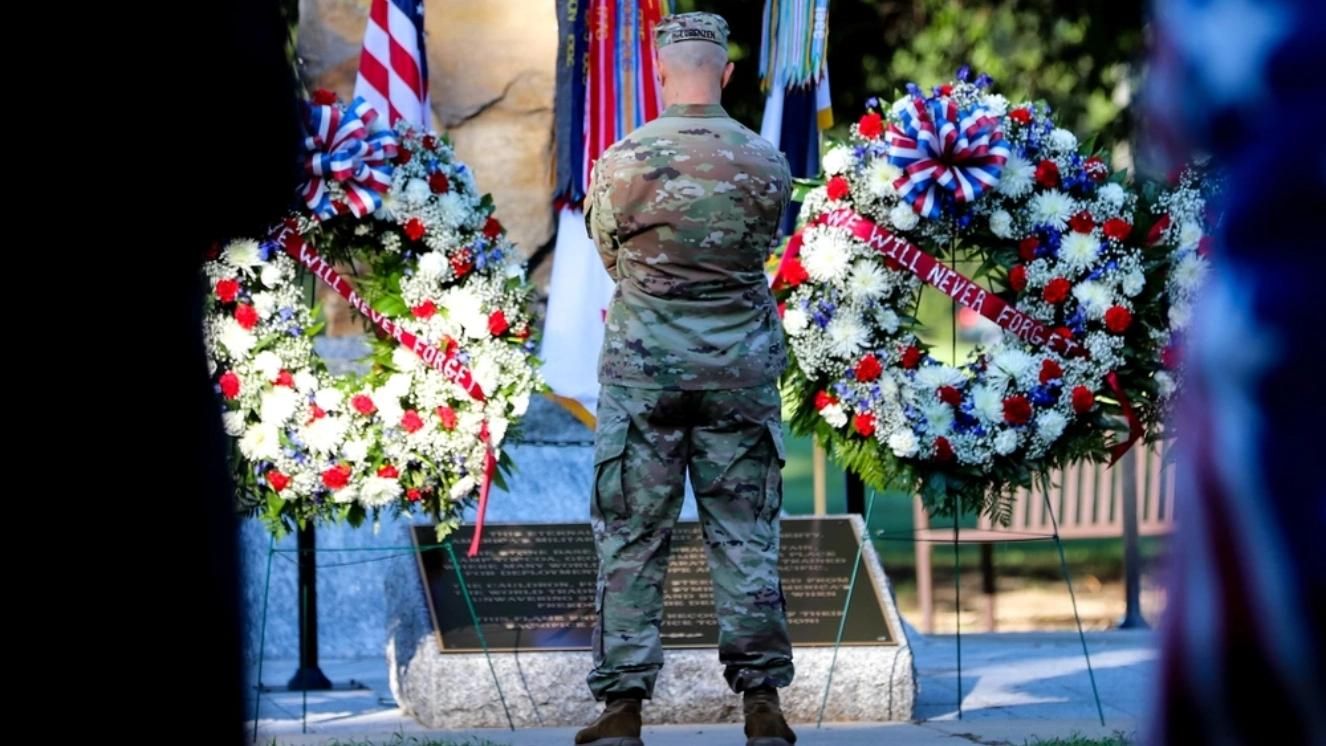
Years later, in my second Pentagon assignment, I was privileged to go to Holy Mass almost daily in the Pentagon chapel, which sits on the point of impact of American Airlines Flight 77 on 9/11, and just down the corridor from my office. There’s a fire-blackened brick on the outside at the exact center of the crash site. It’s a reminder that what happened that day was not abstract—it was hell on earth for those in the planes and on the ground. It’s a constant reminder that being ready is not just how many push-ups we can do or how well we shoot—those things are important, of course—but how well we do the mundane and difficult things daily to ensure our force is supplied, that intelligence is good, that our cooperation with allies is solid, that we are clear-eyed about who is an enemy and who is an adversary.
9/11 is also a stark reminder of the value of our alliances. The only time Article 5 of the NATO Treaty—the part that says an attack on one is an attack on all—was ever invoked was after 9/11. NATO AWACS deployed to the U.S. and supported air defense. NATO soldiers deployed and bled with Americans in the mountains and deserts of Afghanistan. As a share of its military’s size, Denmark lost more killed in action than any other country in that war, including America. Canadians, Germans, Brits, Danes, Italians, and many others stood with America in our hour of need. As the saying goes, if you’re going to fight—bring friends.

A decade later, I began what would be my last assignment as Director of Installations & Mission Support at Headquarters, Pacific Air Forces. It was going home in a real sense because I had been assigned to that very headquarters as a captain. I was reunited with old friends, and now sat at the desk of men whom I had admired as a young officer. The Pacific Air Forces Headquarters building was a barracks on December 7, 1941, when Imperial Japanese forces attacked air and naval installations across the island. The “Hale Makai,” as it was known then, took a bomb directly in the dining hall where servicemen were having a leisurely Sunday breakfast. The building still bears pockmarks and bullet holes. Just like that blackened brick at the Pentagon, those scars of war were left unrepaired—a constant reminder of what happened there on their own “9/11.” Each day, walking up the stairs to my office, I passed those bullet holes in the building and the stairwell.
Those bullet holes reminded me of the fragility of peace, and the necessity for someone—us—to be prepared to stand between our fellow Americans and the abyss of war.
Days like this remind us of what we share as Americans: the desire to live free, to remain so, and to live up to the ideals of our founding. They also remind us that all of us, as Americans, can contribute to making “never again” a promise rather than a lament.
It’s also a challenge to rise above the anger of the moment. It’s a challenge to remember the allies who bled with us. It’s a challenge to recall who we are as a country when we are at our best, and a charge to return to who we are again.
Editor's note: This article first appeared on Mickey Addison's Substack, The America I Long For, a book-in-progress exploring American civic life, democracy, and the habits of character required to sustain a free and pluralistic society.
Continue Reading
Where Were You? A Veteran’s Reflection of 9/11 and the Aftermath
Lifestyle
Remembering Patriot Day: A Tribute to Resilience and Unity
Lifestyle
Join the Conversation

BY MICKEY ADDISON
Military Affairs Analyst at VeteranLife
Air Force Veteran
Mickey Addison is a retired U.S. Air Force colonel and former defense consultant with over 30 years of experience leading operational, engineering, and joint organizations. After military service, he advised senior Department of Defense leaders on strategy, readiness, and infrastructure. In additi...
Credentials
Expertise
Mickey Addison is a retired U.S. Air Force colonel and former defense consultant with over 30 years of experience leading operational, engineering, and joint organizations. After military service, he advised senior Department of Defense leaders on strategy, readiness, and infrastructure. In additi...