70 Years Tracking Santa: Remembering the Night We Logged an Unknown Rider

This year will mark the 70th time that the North American Aerospace Defense Command (NORAD) will track Santa on Christmas Eve as he pilots his sleigh, pulled by eight (sometimes nine) reindeer across the skies of North America. To mark the anniversary, NORAD is making a pretty big deal about this annual event … as it should be. Santa’s a pretty important guy to most North Americans.
Usually, Santa and NORAD’s mission go off without a hitch. Santa is a very professional pilot. He follows his flight plan, monitors his radio closely, and enters the correct codes into his sleigh’s transponder. However, that didn’t happen one Christmas back in 1987 … and I was there.
Christmas Eve, 1987: A Quiet Night at SEADS
It started out as a very quiet evening at the Southeast Air Defense Sector at Tyndall AFB, FL. The holidays were normally a pretty quiet time period. Even those godless Russkies rarely flew their Bear Bombers through our Air Defense Identification Zones (ADIZ) during the Christmas holidays.
As we normally did during that time of year, we broke down our midnight shift mission crews to the minimum personnel required to surveil our assigned airspace, identified all the air traffic, and, if necessary, scrambled alert fighters and controlled them to unidentified targets entering U.S. airspace.
I was the crew Weapons Director who, if we had to scramble fighters, would control them to their targets. We were sitting in the break room playing spades just a few hours after midnight when our card game was interrupted by a call on the intercom from the operations floor: “Weapons Team report to ops … unknown rider in the system!”
An Unknown Rider Appears
We hustled to the ops floor and assumed our positions on scope. The surveillance tech sent me a pointer to the unknown aircraft—or so I assumed—that was not squawking a Mode 3 code.
A Mode 3 is a code used by civilian aircraft that enables civilian air traffic control, as well as military air defenders, to identify them.
I made the required number of “unknown rider” calls on the radio, trying to clue the pilot in that their transponder was apparently not working. I received no response on the radio, nor did the track start to emit a Mode 3 code. It was time to scramble the alert fighters from Jacksonville International Airport, FL—the most exciting part of our job.
Scrambling the Fighters
The Florida Air National Guard’s 125th Fighter Interceptor Group (FIG) at Jacksonville had just replaced their venerable F-106 Delta Darts with F-16s earlier that year. The 125 FIG was the first Air National Guard unit to fly the Air Defense Fighter (ADF) version of the F-16, which meant that they could carry the AIM-7 radar-guided missile—something other F-16s couldn’t do.
As luck would have it, my high school classmate, 1Lt Bill “Yogi” Bair, was sitting alert that night at Jacksonville when the claxon went off, and he and his flight lead ran to their jets and quickly got airborne.
“Mustang McKinley, my flight lead, and I were watching a VHS movie when the horn went off,” Yogi recalled. “We expected another slow night sitting alert … and then things got interesting.”
Closing on the Target
Back at the SEADS, we took a hand-off from Jax Center of the two F-16s—call-sign Echo Hotel flight—a few miles after they went “feet wet” off the coast of Jacksonville. The fighters checked in, and I gave them vectors to the unknown track.
What alarmed us about this particular track was its speed. It was moving way too fast to be a Russian Bear Bomber and almost too fast for the supersonic-capable F-16s to track it down if they got into a tail chase.
To make matters worse, the target was flying pretty low—less than five thousand feet—and the weather wasn’t great.
The F-16s got a lock on the target and electronically interrogated it for all modes. They got nothing back. I cleared them to approach close enough for a visual identification. I watched the fighters move to within a mile or two from the target on my scope and eagerly awaited their words.
After what seemed like an eternity, Mac’s voice broke through the static.
“Oakgrove, Echo Hotel, you’re not going to believe this,” Mustang exclaimed.
“Echo Hotel, Oakgrove, try me,” I jokingly—and unprofessionally—responded.
“Oakgrove, Echo Hotel, VID Santa’s sleigh and, I believe, nine tiny reindeer. Judging by the red beacon, it looks like Rudolph’s on the team this year.”
Completing the Mission
Needless to say, the entire SEADS crew thought Mustang was pulling our legs.
“Echo Hotel, Oakgrove, please confirm Santa’s sleigh and nine reindeer,” I queried.
“Oakgrove, Echo Hotel, affirmative … the fat man himself,” Mustang came back.
I looked at our crew commander, a crusty old Major named Fred Bredehorst, who was on the phone with the SEADS Battle Director—a full Colonel whom we had woken from a deep sleep after a reportedly festive Christmas Eve party.
At that moment, Santa’s Mode 3 almost magically appeared on my scope. As it turns out, he’d been having equipment problems. Mac used hand signals and his jet’s spotlight to let Santa know that his sleigh’s transponder wasn’t working.
One of Santa’s elves—possibly named Herbie—was along for the ride and did some quick in-flight maintenance to bring the transponder back to life.
Major Bredehorst relayed the update, and we were directed to tell the fighters to return to base while Santa proceeded on his merry way. Mission complete and crisis averted.
OK, much of that wasn’t true. Or, as Yogi would say, “It’s the 10% fighter pilot rule.” After 45 years of working with those guys, I’m still not sure if that means 10% or 90% of what a fighter pilot tells you is true.
The Ground Truth About Santa Tracking
The truth is that NORAD will once again track Santa this year with the help of their Air Defense Sectors. NORAD has launched a NORAD Tracks Santa website where you can follow the action.
It features Santa’s North Pole Village, including a holiday countdown, games, a movie theater, holiday music, a web store, and more. The site is available in nine languages.
The official NORAD Tracks Santa app is available in the Apple App Store and Google Play. NORAD Tracks Santa will also be available on digital media platforms, including Facebook, Instagram, YouTube, and X, as well as connected platforms such as Amazon Alexa, SiriusXM, and OnStar.
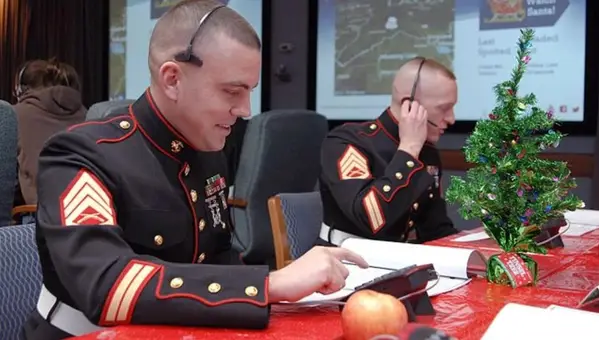
On December 24, Santa trackers worldwide can call 1-877-HI-NORAD from 4 a.m. to midnight Mountain Standard Time to ask live operators about Santa’s location. A web-based calling option is also available through the NORAD Tracks Santa website, with virtual translation services supporting more than 200 languages.
After midnight MST, trackers can continue following Santa’s flight until 3 a.m. on December 25 via NORAD’s Interactive Voice Response system or the website.
NORAD’s Real-World Mission
NORAD is a United States and Canada bi-national organization charged with the missions of aerospace warning, aerospace control, and maritime warning for North America.
NORAD prevents air attacks against North America, safeguarding the sovereign airspaces of the United States and Canada by responding to unknown, unwanted, and unauthorized air activity approaching and operating within these airspaces.
In addition to the phone line and website, children and the young-at-heart can track Santa through NORAD’s mobile apps and their social media platforms:
- YouTube
- NORAD Tracks Santa Website
- NORAD Tracks Santa Newsroom
Post Script:
While most of the Santa intercept story is fabricated, some of it is true. I did serve at the SEADS as a Weapons Director in December 1987. However, my high school classmate Yogi was not flying F-16s at Jacksonville at the time. He never flew F-16s—something he remains very proud of.
Yogi joined the 125th Fighter Wing in 1999 after it transitioned to the F-15 and retired as the 125th Operations Group Commander in 2011. Major Bredehorst has since passed away, but he remained crusty until the end. He was originally from Queens, like me, and we shared a love for the New York Mets.
Continue Reading
Col. Harry Shoup's NORAD Santa Tracker Legacy
Military History
Join the Conversation
BY GEORGE RIEBLING
National Security Analyst at VeteranLife
Air Force Veteran
George Riebling is a retired USAF Colonel with 26 years of distinguished service as an Air Battle Manager, including operational assignments across five command and control weapon systems. He holds a Bachelor of Journalism, Radio & Television from the University of Missouri. Following his military c...
Credentials
Expertise
George Riebling is a retired USAF Colonel with 26 years of distinguished service as an Air Battle Manager, including operational assignments across five command and control weapon systems. He holds a Bachelor of Journalism, Radio & Television from the University of Missouri. Following his military c...