The Stories They Never Told: Why Organizations Are Racing to Preserve Veterans' Legacies

Every American Veteran is a historymaker with an important story, whose life and actions have shaped our country in the present day. This is something that I learned firsthand in elementary school, when I wrote an essay about my grandfather’s military service during the Korean War.
He wasn’t the most chatty man, so we decided the easiest way to conduct an interview of sorts would be if I wrote down my questions and he wrote his answers back.
I got the information I needed, but more importantly, I got a tangible account of his service, in his own words. My only regret is that I didn’t push to record a full interview so that our family would be able to listen to him tell the stories himself.
At the time, I didn’t know that there were countless organizations across the country devoted to recording Veterans’ stories and preserving them that could have supported me in that effort. Now, nearly 20 years later, recording that kind of interview is as easy as downloading an app on my smartphone.

National Preservation Efforts: The Library of Congress Veterans History Project
While grassroots organizations and families like mine had been recording Veterans’ stories on a case-by-case basis for decades, it wasn’t until 2000 that lawmakers formally recognized the need to preserve the first-hand accounts of our nation’s service members on the record before they were lost forever.
In October 2000, Congress unanimously passed the Veterans’ Oral History Project Act (Public Law No: 106-380), officially charging the Library of Congress with the crucial duty of collecting and preserving Veterans’ stories. Known as the Veterans History Project (VHP), this oral history program was intended “to collect video and audio recordings of personal histories and testimonials of American war Veterans.”
In 2016, the original legislation was amended with the passing of the Gold Star Families Voices Act (Public Law No: 114-246), which added the collection of oral histories from families of service members who died as a result of their service during a period of war to the project's scope.
After 26 years of dedicated work on this project, the Library of Congress has collected over 120,000 first-hand accounts from Veterans of the United States Armed Forces. Stories have been submitted from every ZIP code and Congressional District in the country, as well as from every U.S. Territory, Commonwealth, and Protectorate. Roughly 70% of these accounts are digital recordings that can be viewed online.
Over 2,700 organizations and countless individuals have contributed to the Veterans History Project collection.
“The collection is built through the work of Veterans, family members, students, educators, scouts, volunteers, libraries, museums, archives, universities, historical organizations, Veterans groups, civic organizations and many others who help preserve these stories,” explained Travis Bickford, Head of Programs and Communications for the Veterans History Project.
“This community-based effort ensures that Veterans’ stories remain connected to the places where they began while also becoming part of the permanent historical record at the Library of Congress.“
Boots on the Ground: The Local and Regional Organizations Interviewing Veterans
Today, thousands of organizations and individuals across the United States are actively working to connect with Veterans and record their stories. In fact, there’s probably at least one organization doing this work in your area right now, and finding it could be as simple as searching Google for “Veterans history project in [insert your city or state].” Many more operate primarily in one location, but also conduct virtual interviews, are willing to travel for interviews, or accept self-submissions.
We spoke with three organizations doing this work in unique ways across the country to better understand the importance of recording and sharing Veterans stories and the many unique ways that this important work can be approached.

The Veterans Museum (Florida)
One organization working on a local level to support this project is the Veterans Museum in Jacksonville, Florida. The organization was inspired by the story of Maj. William J. Hicklin (USAAF), who never spoke much about his military service. It was only decades after his passing that his family found a handwritten account of his World War II experience, along with a Bronze Star they never knew he'd been awarded.
A local filmmaker turned his journals into a 30-minute film about his life, which inspired the Hicklin family to make a foundational donation to the Veterans Museum, an organization that would be dedicated to recording Veterans’ stories.
Over the last two years, the Veterans Museum has recorded over 200 interviews, which can be viewed on its website and on interactive kiosks in museums, libraries, state Veterans’ nursing homes, and government buildings throughout Florida. They’ve also donated every interview to the Veterans History Project for permanent preservation.
Scott Mythen, CEO of the Veterans Museum, emphasized that this work is important for two core reasons. First and foremost, it’s for the Veterans and their families, but it’s also for the greater good of the country in fostering understanding.
“Only 1% of Americans have ever raised their hand to do something bigger than themselves, so that disconnect between [the general public and] those that have served, and more importantly, why they served and what they learned about themselves and the world when they did it. That disconnect would grow even greater if no one was capturing these stories,” said Mythen.

Imprints of Honor (Arizona)
Imprints of Honor is another nonprofit organization that deeply understands the importance of making this connection between Veterans and the general public.
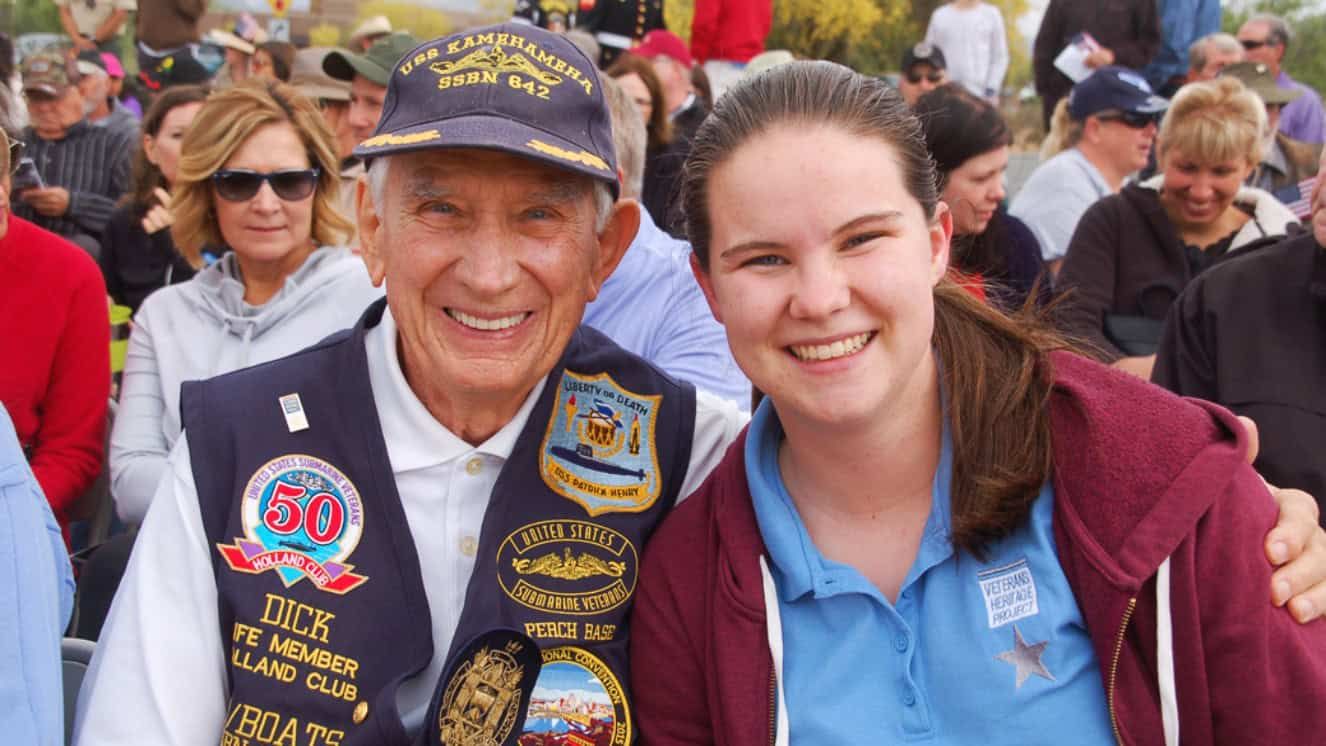
Operating primarily in Arizona, Imprints of Honor partners with teachers to provide an after-school program connecting students with Veterans to record and write their stories. They strive to bridge the gap between civilian and military life while also developing students’ character and civic responsibility.
Since 2004, the organization has facilitated over 3,400 student interviews with Veterans and submitted these interviews to the Library of Congress for preservation. After each interview, students write and edit their Veteran’s story for publication in a hardbound book, Since You Asked. In addition to writing the stories and designing the book for publication, the students also take ownership of planning a book-signing event for Veterans and the community to celebrate each new volume’s release.
The organization’s Executive Director, Michelle DiMuro, shared just how impactful these book-signing events are,
“When I went to my very first book reception, I was so impressed with the interaction between the students and the Veterans - the enthusiasm, the respect, and just how much the Veterans felt appreciated. It has been a life-changing experience… I wish there was something like this when I was growing up.”
The experience is certainly life-changing for both the Veterans and the students. According to DiMuro, more than half of the Veterans they’ve interviewed say the experience was cathartic and healing in some way. For many, their interview was the first time they ever spoke about their service to someone, and participating in the project helped them open up to family and friends about what they experienced.
Meanwhile, the students learn deeply meaningful life lessons from the Veterans they interview. Concepts like service beyond self, how to power through adversity, and how to work together as a team are inherent to every Veteran’s story, regardless of whether they saw active combat. Students learn these lessons first-hand while also learning key details about our nation’s history that go far beyond what is included in their textbooks.

USA Warrior Stories (New York)
USA Warrior Stories is another nonprofit organization that records and shares Veterans’ stories. Co-founders Matt Hindra and Nick Kraus got their start interviewing Veterans in 2014 while creating a documentary film about two fellow Long Islanders, Iraq War Veterans who were working to raise awareness for injured Veterans. The experience inspired them to start interviewing more and more Veterans, and they have now recorded over 300 short films capturing Veterans’ stories.
For USA Warrior Stories, the preservation of each Veteran’s story is important, but only half of the mission. Of these kinds of projects, USA Warrior Stories’ co-founder Matt Hindra explained,
“You find that there's a lot of stories being recorded, but not a lot of them being presented to the public in a way in which people are engaged in the story.”
That’s why USA Warrior Stories takes the time to turn each interview into a mini-biography complete with stock footage and photographs, which is shared publicly on their website and YouTube channel.
Hindra echoed the sentiment of others doing this kind of work, emphasizing the importance of listening to Veterans and honoring their stories through an interview. He added that the engagement with their content online furthers this impact.
“To have somebody to actually write a comment on the YouTube channel or send an email to us that we forward on to the Veteran… it means a lot to them. These veterans share very intimate things that they haven't shared with family members or haven't even thought about in years.”
USA Warrior Stories also has an app that can be used to explore Veterans' stories. Initially, the app was intended to be a place for Veterans to share their stories with a closed community that would understand what they’ve experienced in a way the public might not. Now, the organization is exploring ways to expand the app with features to make it easier for Veterans to record and share their stories on their own with the help of AI tools.

For the DIYers: StoryCorps’ Military Voices Initiative
StoryCorps is a nonprofit organization that works on a national scale to record Veterans’ stories as part of their larger mission. StoryCorps believes storytelling and conversations are at the heart of helping people understand and empathize with one another. The personal stories they record are preserved in the American Folklife Center at the Library of Congress (though in a separate collection from the Veterans History Project) and also shared via the online StoryCorps Archive.
StoryCorps seeks to empower individuals to become active participants in this effort by having and recording their own conversations. Their user-friendly app walks you through how to conduct an interview so you can do it yourself, covering everything from preparing questions to the best ways to record right on your smartphone.
While StoryCorps strives to record the voices and stories of people from all walks of life and every part of the country, they launched a special project in 2012, the Military Voices Initiative, designed specifically to capture the stories of service members and their families. To support this initiative, StoryCorps has created a robust list of great questions that anyone can use to prepare for an interview with a Veteran.
Justin Cummins, Program Lead for the Military Voices Initiative and Associate Director of Interview Collection at StoryCorps, shared his take on the importance of collecting these stories, especially through meaningful conversations with loved ones.
“As a veteran myself, I know that some of the most meaningful conversations don't happen in public. They happen between family members, fellow service members, spouses, or close friends. StoryCorps provides an opportunity for those conversations to take place… We’ve seen families gain a deeper understanding of one another, communities connect through shared experiences, and Veterans leave knowing that their stories will be preserved permanently… That's a powerful legacy.”

Why Share Your Story?
You may not think that you have an interesting story to tell, but every story matters. As Travis Bickford pointed out, the variety of experiences recounted in the VHP collection at the Library of Congress is what makes it so special, from stories of combat and sacrifice to reflections on friendship, routines, and the small details of military life.
“Those details matter because they capture the full human experience of service,” he explained.
“The Veterans History Project is not only a record of major events. It is a collection of memories, experiences, and moments that help us understand the people behind the history.”
As a Veteran, you understand the importance of service to our country. Telling your story can be a continuation of that service, but it can also be an important act of service to yourself.
For many Veterans, the experience of being interviewed is cathartic and healing. It helps them to feel more comfortable discussing their experiences with family and friends. Others, particularly women Veterans and Veterans of the Vietnam War, have expressed that being interviewed allowed them to finally feel the honor and respect that they deserve as Veterans.
How You Can Get Involved Today
There are lots of ways that you can get involved with this effort, whether you are a Veteran yourself, have a loved one who is a Veteran, or are a civilian who just wants to support this meaningful initiative.
Are You a Veteran Ready to Tell Your Story?
If you’re a Veteran ready to tell your story, you’ve got a couple of options. First, find an organization in your local area or state that interviews Veterans. Many of these organizations provide a way to request an interview directly from their websites.
If you can’t find a local organization to work with, there are some great do-it-yourself options. With apps like StoryCorps available for free to help you record, you could always sit down with a friend or family member to tell your story. Depending on your comfort level with technology, you might even consider recording the story and submitting it to one of the many repositories yourself.
If you’re camera-shy, don’t worry! Your story still matters, and we’ve got you covered with other ways to share. The American Veterans Center collects written accounts from Veterans, and their families are invited to send their stories to the AVC directly for publication on their online Veterans tribute, Home of the Brave.
There are also other organizations that choose to preserve Veterans' stories by collecting materials and memorabilia, which you could donate to. For example, the Center for American War Letters at Chapman University collects and digitizes war-related correspondence for every American War dating back to the Revolution. The Veteran’s History Project also recommends some repositories for artifacts you may have and want to donate to help preserve American military history for generations to come.
Not a Veteran, But Still Interested In Supporting These Efforts?
There are many ways that you can support the effort to record Veterans’ stories, even if you are not a Veteran yourself. First and foremost, you could support local organizations doing this work. Many of them are small nonprofit organizations that would benefit greatly from your volunteer service or a donation.
As Scott Mythen explains,
“What we do, it's intangible, but it's super powerful. So, we don't look like the other Vet organizations asking for funding. Because a Vet isn't going to end up with a house at the end of our process. But we know that it helps the Veteran, and then the end product helps the community.”
If you can’t find a local organization to support directly, you have other options. Imprints of Honor titles their books Since You Asked because many Veterans won’t share their stories until someone asks. You can be that someone.
Using resources from the Library of Congress and organizations like StoryCorps, you can go out and start interviewing Veterans in your local area yourself. Local Veterans’ organizations can likely help you get connected with potential interviewees.
According to Travis Brickford,
“The most important step is taking the time to listen. Every collection begins with someone recognizing that a story matters and helping preserve it for future generations.”
Every Veteran’s Story Matters
The bottom line: every Veteran has an interesting story to tell that has shaped American history as we know it. Truly understanding history is about more than just memorizing facts and timelines - it’s about connecting with and understanding the people who were there living through it.
Preserving Veterans’ stories is one way that we can ensure future generations have access to the fullest picture of American history in the words of those who directly contributed to it. It’s also a great opportunity to show respect and support Veterans in a way some have never experienced before.
Veterans, no matter what you think of your story, there are scores of people who would be honored to hear it. Please consider sharing it with one of the many organizations recording and preserving Veterans’ stories.
To all others, support this effort in any way you can. Scott Mythen put it best, “anyone can capture these stories… it doesn't have to be us [at the Veterans Museum], just as long as it's happening.”
Continue Reading
Veterans Heritage Project Helps New Generations Honor Veterans
Lifestyle
Organizations Honoring Fallen Heroes Year-Round
Lifestyle
From Service to Sports: 12 Veterans Who Became Athletic Icons
Lifestyle
Join the Conversation

BY DANA CONGELOSI
Military Spouse and Contributing Writer at VeteranLife
Marine Corps Veteran
Dana is a military spouse who has spent more than five years navigating the unique rhythms of military life alongside her partner. She holds a Bachelor of Arts in History and Anthropology from St. Lawrence University and has built her career across museums, public libraries, and recreation. Thro...
Expertise
Dana is a military spouse who has spent more than five years navigating the unique rhythms of military life alongside her partner. She holds a Bachelor of Arts in History and Anthropology from St. Lawrence University and has built her career across museums, public libraries, and recreation. Thro...